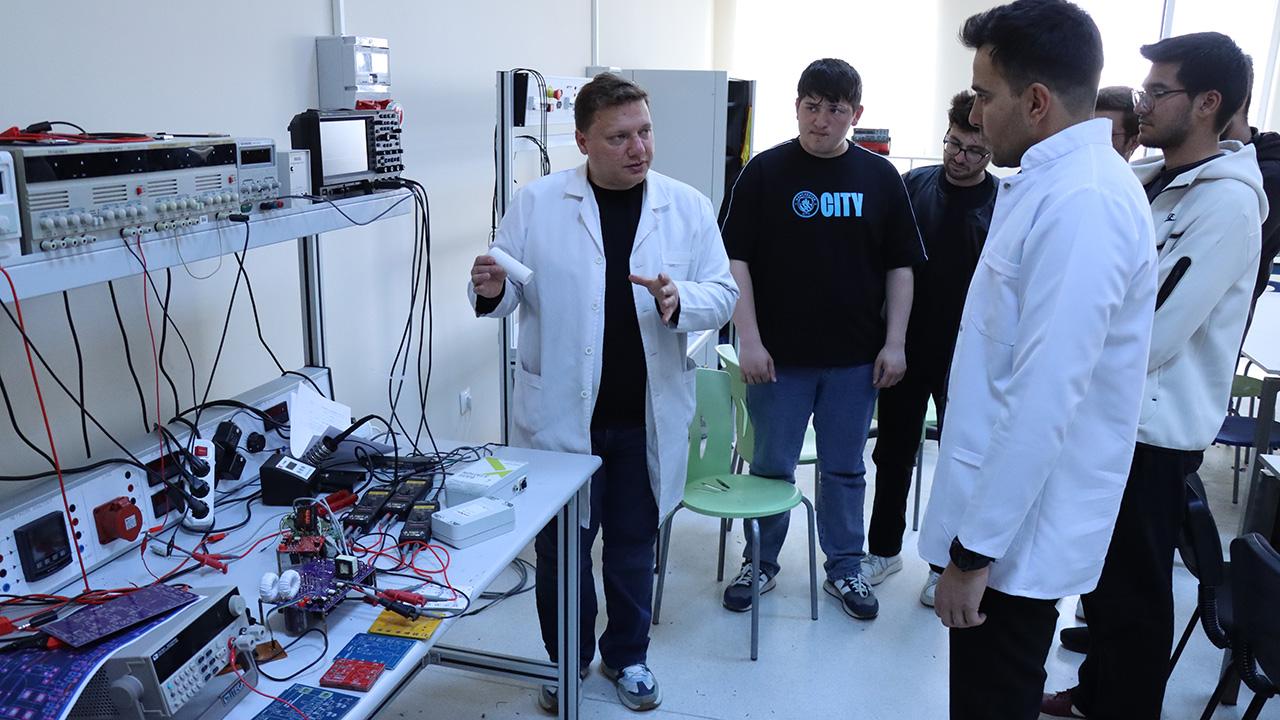
The project “Development of Local Romanian Sensor Boli for Cattle Health Monitoring”, which is eligible for funding under the National Research Support Program for New Ideas and Products TÜBİTAK-1005, is carried out in collaboration with Atatürk University, Erzurum Technical University (ETÜ) and Erzincan Binali Yıldırım University (EBYÜ) under the coordination of Sivas University of Science and Technology.
The project aims to accelerate the digital transformation in animal husbandry in Turkey and immediately monitor the health of cattle by developing rumen sensor boluses (sensor capsules in the stomach of animals), which are currently mostly imported from domestic resources.
Dr. Lecturer and member of the EBYÜ Department of Electrical and Electronics Engineering, Agah Oktay Ertay, said that work on the project to develop a rumen sensor bolus to improve cattle health continues.
“We want to increase the milk and meat yield in cattle breeding in Türkiye”
Ertay explained that the project is a multidisciplinary study involving experts from four universities:
“Rump Sensor Bolus is a product that is imported and used. By producing this product in our country with domestic and national resources, we aim to increase milk and meat yield in livestock farming in Turkey. We place this sensor in the part of the animal's stomach that we call “rumen”. After placing it, we now measure the ambient temperature and the pH levels in the animal's stomach with continuous data. In other words, we carry out all the activities that are taking place in the animal's stomach at that moment “After receiving them, we can substantiate our predictions for the future, such as what the animal's milk production will be in the next 6 months, whether it is time for estrus and whether we can increase its meat capacity.” When we place this rumen sensor bolus, we can look for answers to questions such as whether the animal is about to give birth, whether it is in a stage of illness, whether it is about to get sick, or whether it is going to get sick.”
Ertay noted that calf mortality in Turkey is about 15 percent, while in countries that actively use rumen sensor bolus this rate is about 2 to 3 percent.
“One of our farmers takes his tablet, looks at it and examines the animal’s data.”
Ertay pointed out that calf mortality will decrease if the product to be developed is widely used in Turkey, saying:
“The outside of this rumen sensor bolus is a product made of polymer material. In other words, when we put it in the animal's stomach, it will not harm the animal's stomach in any way and can stay in the animal's stomach for over 5 years. After checking the data, they will say: “The estrous period is coming” or “She is about to give birth” or “She will be sick soon.” “He will be able to read this data from the tablet.”
Explaining that after producing the Romanian sensor bolus, they will be placed in the stomachs of 10 animals and tested, Ertay said: “It is an 18-month project. Our goal is to digitalize agriculture and animal husbandry. If this project is successfully completed, we want to make a significant contribution to the development of sustainable agriculture and animal husbandry. In addition, as stated in the 12th Development Plan, the number of cattle in Türkiye is expected to reach a higher level.”
Bir yanıt yazın