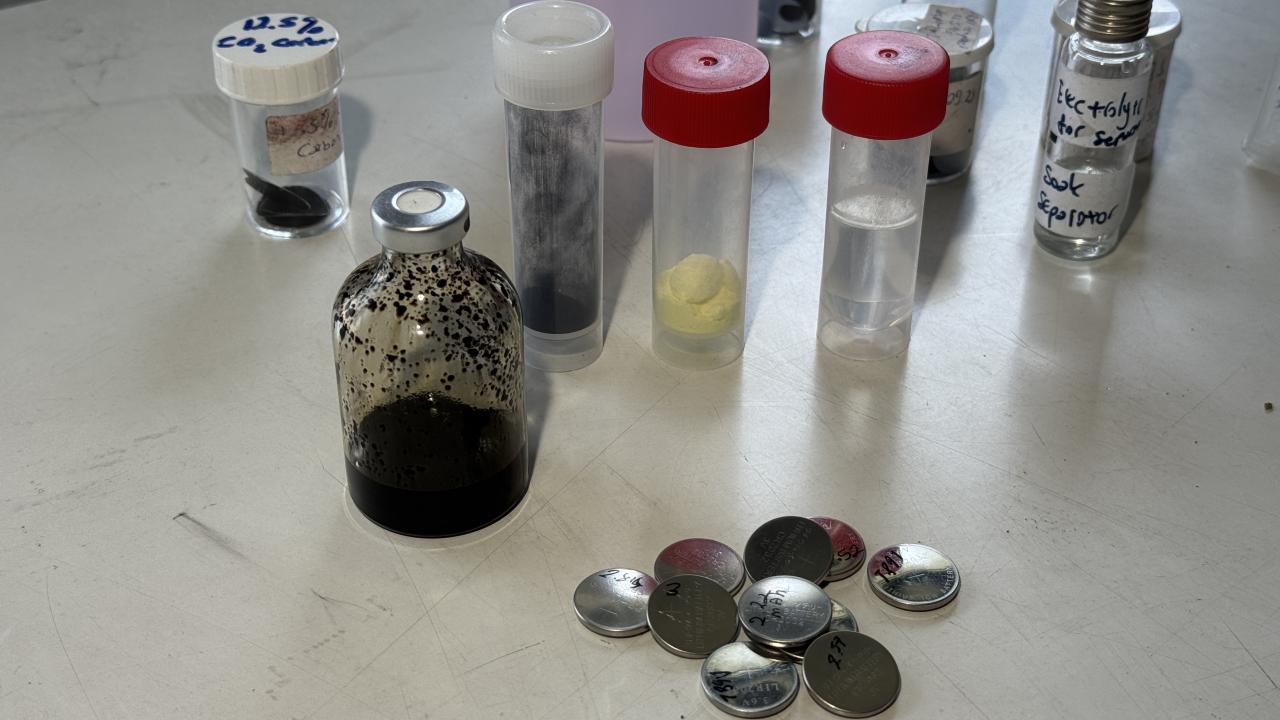
YTU Metallurgy Department Lecturer Assoc. Dr. Work was initiated by Ali Can Zaman and his team to develop new generation battery technologies that are long-lasting and can be charged quickly.
In this context, scientists reacted acetone and elemental sulfur using a unique polymerization method.
The study developed a polymer that can store energy like sulfur and also has hydrophobic properties.
The developed polymer will contribute to the development of new generation battery technologies that are long-lasting and can be charged quickly.
Electroactive Polymer has also been registered by the Turkish Patent and Trademark Institute.
“We actually obtained a polymer that has hybrid properties”
Assoc. Dr. Ali Can Zaman said their ultimate goal is to introduce technology that extends the life of batteries and enables faster charging.
Zaman explained that they focused their research on lithium-sulfur batteries and that the elemental sulfur used as cathode material in these batteries is very cheap, abundant and one of the important by-products of the petrochemical industry.
Zaman noted that the direct use of sulfur as a battery material makes it difficult to develop long-lasting batteries due to its hydrophobic structure.
Zaman explained that they developed a new polymerization technique to overcome this disadvantage:
“Using this method, we obtained polymer materials by reacting elemental sulfur with organic compounds that are not expected to react under normal conditions. We realized that we can suppress some of the negative properties of sulfur. Although the newly obtained material has some properties of sulfur, it also has the properties of organic compounds. In fact, we obtained a polymer that exhibits hybrid properties. Acetone is a well-known simple organic compound.”
Thanks to the method we developed, we obtained a new polymer material by reacting acetone with elemental sulfur. The materials obtained have electroactive properties and can therefore store energy. “The results, after sufficient optimization studies, could pave the way for the development of batteries that last longer and can charge and discharge faster.”
Zaman pointed out that although similar studies have been carried out before, reacting a simple molecule such as acetone with elemental sulfur using this method to obtain a new class of materials is a unique approach in the literature.
“The material developed can also be used in water treatment in the future.”
Assoc. Zaman explained that the material is not just limited to batteries: “Derivatives of these materials can also be used in carbon capture applications. We have implemented these applications and achieved good performances. In doing so, we have proven that they can be used in both energy storage and carbon capture areas.” he said.
Zaman pointed out that the developed material could also be used for water purification in the future due to its sulfur-containing structure, saying that it has the potential to absorb heavy metals by acting like a sponge, especially in removing mercury pollution in water.
Zaman stated that the material can also be used in gas separation and adsorption applications, noting that its carbon dioxide capture derivatives also produced successful results.
Bir yanıt yazın