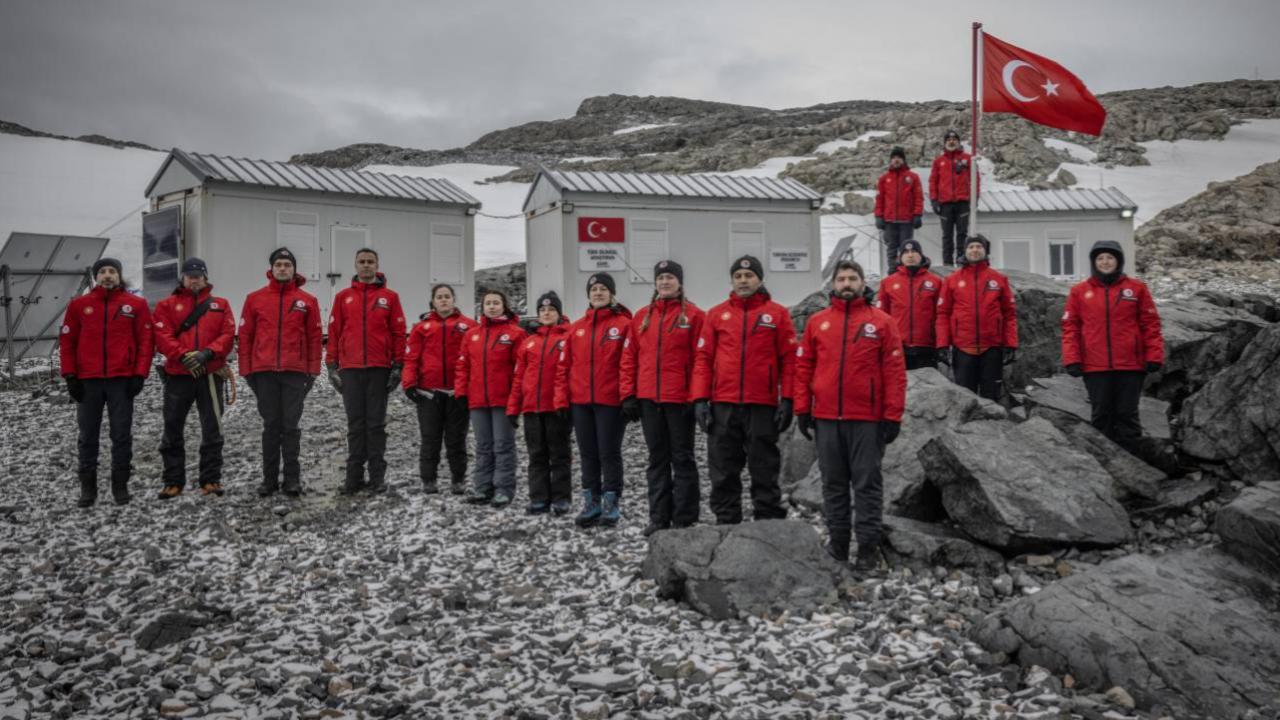
After their 11-day journey, the Turkish science team reached the Turkish research camp on Horseshoe Island, its home on the White Continent at the 68th parallel south.
During the expedition, which is taking place for the 10th time this year, a total of 17 researchers, including 16 Turks and 1 Bulgarian, will carry out studies in the fields of life, life, physical and earth sciences.
To study the effects of climate change, the team will collect ice samples and water samples from lakes and marine areas and conduct comprehensive analyses. In addition, data is collected on biodiversity in the region, research on aquatic ecosystems, geology and near space.
The ship, named Sola, which will be the scientists' home for about a month, completed its journey, which began on King George Island, about four days later and anchored off Lystad Bay, Horseshoe Island.
The team of the 10th National Antarctic Science Expedition arrived at the Turkish research camp by boats to begin work. Later, the 17-member scientific team raised the Turkish flag and sang the national anthem.
“It makes me proud to have been organizing expeditions to the same region for 10 years.”
The leader of the 10th National Antarctic Science Expedition, Prof. Dr. Ersan Başar, stating that it is a matter of pride to organize expeditions to the same region for 10 years, said: “We will continue our scientific work here. We will carry out scientific projects in the fields of marine science, earth science, glaciology and atmospheric science with our 17 scientific researchers. Coming here again today made us very happy and proud. Because the Turkish scientific expedition started in Antarctica.” 10th time.” he said.
Başar continued his words as follows:
“For us, it is really a pleasure to be in Antarctica on our 10th expedition in 2026. When we left the ship and approached the camp with the Zodiac boats, there was great excitement because we came to the island for the 10th time. After arriving on the island, we opened the doors of our base and felt at home, even though we were 14,000 kilometers away from Türkiye. We hoisted ours together Flag, along with all of our teammates.” “We will begin our work together on the 10th Antarctic Science Expedition in 2026 by singing the national anthem.”
The Dismal Island stage is complete
In the first leg of the expedition, the team set off from King George Island and reached Dismal Island on the third day of their voyage. It passed through Bransfield Strait, Gerlache Strait, Neumayer Canal, Lemarie Canal, Hovgaard Island, Penola Strait, Grandidier Canal, Gunnel Canal and Barlas Canal.
The maintenance work on the Global Positioning System (GNSS) station, which was built here 6 years ago, has been completed and data backup work has been carried out.
This is Prof. Dr. Explaining that they came to Dismal Island to carry out work within the scope of the expedition, Ersan Başar said: “We are working on maintaining the GNSS station of the General Directorate of Mapping (HGM) on Dismal Island, collecting the data on it and setting up new systems. We went with our team and when we checked the system, we found that the system worked very well compared to last year. All our work continues.” he said.
One of the team members, Petty Officer Senior Sergeant Muharrem İspekter from the General Directorate of Mapping (HGM), stated that they were on Dismal Island for the sixth time as part of the expedition and said:
“We have carried out the maintenance and repair work on our fixed Global Positioning System station here. Due to the harsh weather conditions, we are completing its sustainability. We are evaluating the data we collect here with the scientific software we use and studying the tectonic movements there. After completing our work on Dismal Island, we are carrying out our static measurements on our 7 terrestrial geodetic points on Horseshoe Island using our Global Positioning System device. The movements here and the measurement studies we have carried out are critically important.”
During the cruise, scientists also observed various icebergs, glaciers and creatures at the South Pole.
Bir yanıt yazın