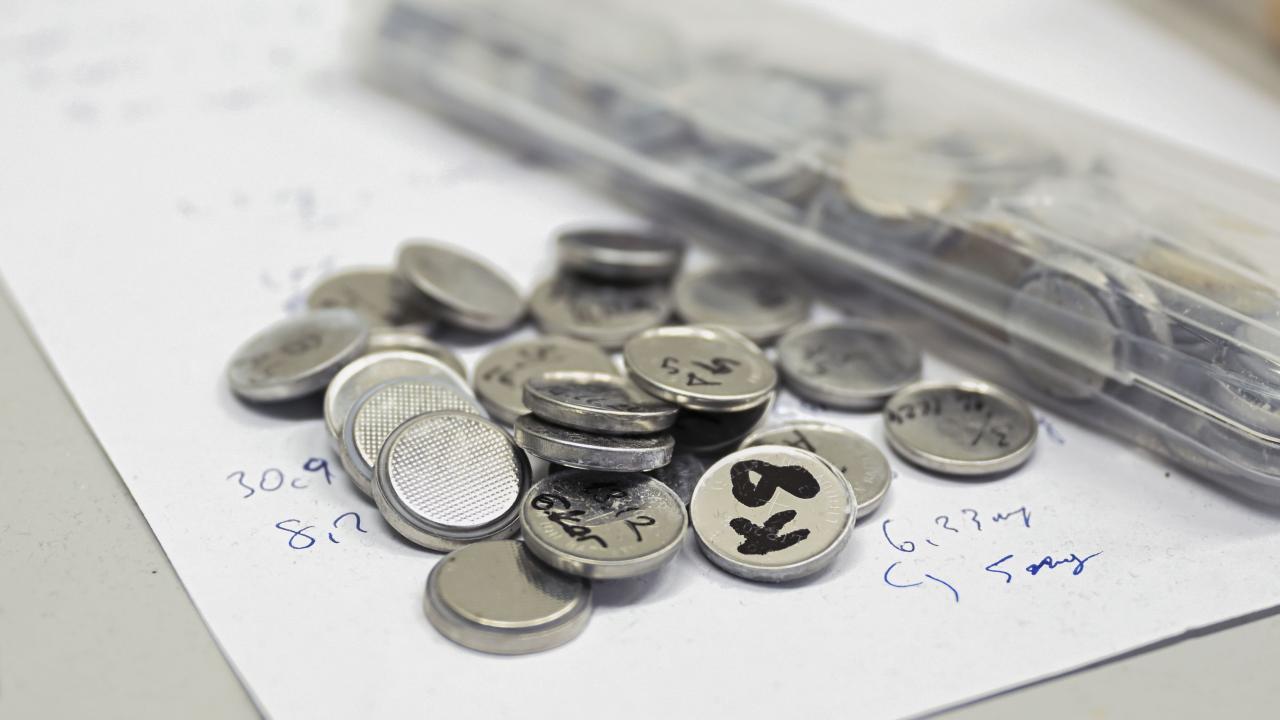
The problem of lithium-ion battery waste, which has increased rapidly in recent years with the widespread use of electric vehicles and portable electronic devices, poses new challenges to the environment and the economy.
According to reports from the United Nations Development Program (UNDP), it is estimated that by 2025, approximately 900,000 tons of lithium-ion batteries worldwide will have reached their useful life and become waste.
According to forecasts in the reports, this figure is expected to reach 11 million tons worldwide in 2030, while the environmental problems caused by batteries are seen for many states as a problem that already needs to be solved.
YTU Faculty of Chemistry and Metallurgy, faculty members of the Department of Metallurgy and Materials Engineering Prof. Dr. Metin Gençten, Assoc. As a solution to this problem, Dr. Burak Birol and Dr. Sezgin Yaşa an innovative method that allows the recovery of materials used in battery production, especially cobalt sulfur, from end-of-life lithium-ion batteries.
Registered by the Turkish Patent and Trademark Office, this innovative method offers a solution that focuses not only on eliminating the problem but also on reproducing it.
Other substances, particularly cobalt sulfide, are recovered from the cathode material of used batteries through chemical processes. The resulting material can be used in a variety of applications, from energy storage systems to sensing technologies.
With the method they developed, the researchers want to reduce environmentally harmful waste pollution and produce a valuable raw material for industry. This approach transforms recycling processes from a cost factor into an economic opportunity.
While the method highlights Türkiye's potential in environmental technologies and sustainable production, it also offers a solution model that draws attention to the increasing problems related to lithium-ion battery waste worldwide.
“Approximately 1 million tons of lithium-ion battery waste is generated each year.”
On this topic, Prof. Dr. Metin Gençten said that his own work ideas came about by using previously functioning systems as a source.
Gençten stated that lead can be recycled to a large extent, but this recycling is not yet fully widespread in lithium systems.
Gençten stated that about five to six years ago, when the amount of lithium battery waste began to increase, they began to question whether the active materials in these batteries could be recycled and reused. “First we looked at recycling lithium cobalt oxide-based batteries, then we looked at different lithium-based battery chemistries and asked, 'Can we convert all the components here into a reusable form?' We set off. At this point, we first looked at reusing active materials in supercapacitors. This took the form of precipitation of metals as sulfides and their recovery. However, in our further work, the recycling of anode and cathode materials directly occurring in the chemistry of lithium-ion batteries has become our main focus.” he said.
Pointing out that one of the most important starting points is the amount of waste generated annually, Gençten said:
“Currently, about 1 million tons of lithium-ion battery waste are generated every year. Most of this waste is waste batteries such as mobile phones and laptops for household use. However, electric cars have become widespread in recent years, and due to the increasing number, a large amount of lithium-ion battery waste will be generated in the near future. We have focused on whether these wastes can be reused as a resource for primary use. Again, NMC cathode made Nickel Manganese Cobalt Batteries (NMC). “We aim to recover and synthesize the active ingredient, the LFP cathode active ingredient from lithium iron phosphate (LFP) batteries and the graphite used in the anode component.”
“It means providing an important resource for the country’s economy.”
Emphasizing that their work can make a big contribution to the country's economy, Gençten said: “Lithium is a critical resource, not a metal that is produced in every country. Manganese production is important in the same way. It is becoming a problem.” he said.
Pointing out that the materials in waste batteries are actually of high purity, Gençten said: “What you call a waste battery does not contain a high level of impurities like what you get from a normal mine. It mainly contains the components we mentioned in pure form. Therefore, effectively recycling all these metals means providing an important resource to the country's economy.” he said.
Gençten noted that storing used batteries poses a great risk and economic loss in terms of both safety and the environment:
“We can effectively recycle these metals and use them with high efficiency in cathode material synthesis to eliminate external dependencies. Because in the structure of an electric car, between 400 and 800 kilograms of battery are used, depending on their average capacity and range. This includes, depending on the capacity, about 10 kilograms of lithium, separately 40 to 50 kilograms of manganese, nickel, cobalt and 50 to 100 kilograms of graphite.
By recycling the active components, the batteries produced can be reused in all areas suitable for their primary use, especially in cell phones and electric vehicles. There is great potential here to eliminate foreign dependency. “Because of our location, I think we’re in a good place as far as lithium-ion battery waste collection goes.”
Stating that the concept of waste has changed significantly, Gençten said: “Most of the components that we consider as waste used in processes or process waste used in a material are either the input of another system or can be recycled and converted into components suitable for primary use. In today's world, this set of concepts that we call waste must be viewed in this way. Each of them has recyclable and economic potential. If we approach materials in this way, I think we will take an important step in the process with a view to a sustainable world.” he said.
“If we recreate it through recycling, we keep the raw material in our country.”
Assoc. Dr. Burak Birol said that under normal conditions, metals and materials from natural resources called ore are used, that when these resources are used, the raw material occurs in the ore in small quantities, and a lot of energy is spent on metal production.
Explaining that metals and materials are used for a while after they are extracted and then their lifespan expires, and over time these materials are referred to as waste, Birol said: “However, large quantities of these metals are contained in these wastes. Their reuse as raw materials offers the possibility of production with less energy and higher purity compared to production from ore.” he said.
In this way, this application called City Mining offers the possibility of obtaining high quality products at a lower cost compared to normal mining. Birol said: “The same applies to batteries. Batteries contain a large amount of nickel, manganese, cobalt and lithium. Mining these materials requires a lot of energy and work and is limited in various countries. However, if we recreate it through recycling, i.e. city mining, we can keep the raw material in our own country and produce it cheaper and of higher quality.” he said.
Birol explained that every material and product used today contains a battery:
“Increasing electric vehicles, solar panels, which we call sustainable energy… The energy obtained from wind turbines accumulates in batteries, and over time these batteries become waste again. If these materials are valued as raw materials before they become waste, both external dependence is reduced and these resources are preserved in the country. In particular, the zero-waste approach is of great importance in this regard. Because these waste batteries are harmful to the environment. Recycling becomes more important to reduce the damage they cause to the environment to inflict, to prevent.”
Bir yanıt yazın