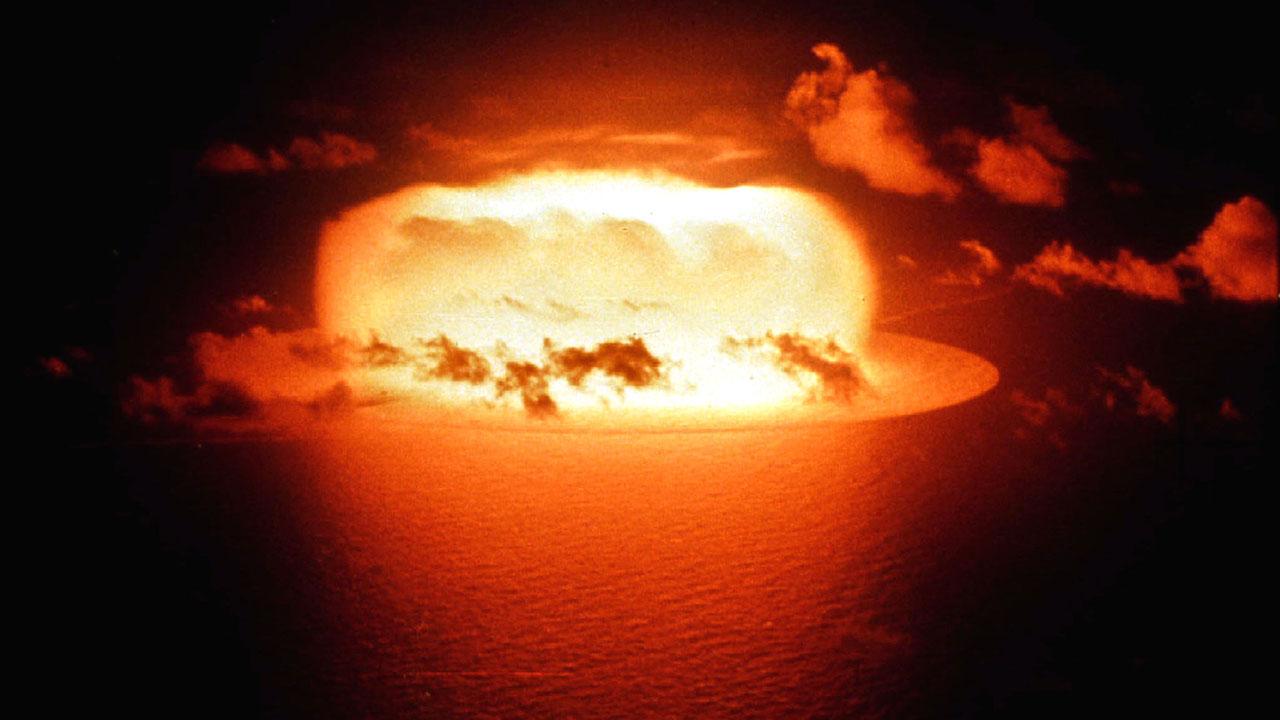
Understanding the consequences of the spread of radioactive fallout into the environment following a potential nuclear disaster or explosion is critical for disaster management and safety planning.
Researchers at the Lawrence Livermore National Laboratory (LLNL) in the US simulated a small model of a nuclear fireball in the laboratory using a high-temperature plasma tube.
In this controlled experiment, in which no real nuclear reaction took place, scientists had the opportunity for the first time to closely observe how the substances vaporized in the nuclear explosion turn into particles during the cooling phase.
5,000 degree hot fireball in the plasma tube
The experiment used uranium, a nuclear fuel, cesium, a radioactive byproduct, and cerium elements, which represent plutonium. In the approximately one meter long plasma flow reactor, these elements were heated to a level close to the surface temperature of the sun, i.e. 4,727 degrees Celsius.
Given this enormous heat, all matter vaporized instantly, just like a real nuclear explosion. The researchers then tested the cooling processes of the materials in two different scenarios.
In the first scenario, the materials were allowed to cool continuously and regularly, while in the second scenario, the temperature was kept very high for a long time and then suddenly dropped.
Unexpected behavior of cesium surprised
The results of the experiment were such that they shook established theories of nuclear fallout. The elements uranium and cerium began to condense and solidify in the early stages, as expected in both cooling scenarios. However, cesium, a radioactive substance, puzzled scientists.
Cesium concentrated much later than other elements. More importantly, in the second scenario, in which the temperature was kept high for a long period of time, cesium was found to interact much more intensively with other elements and form much more complex chemical compounds than expected.
Future disasters are being decoded
This study has shown that traditional core cloud models may be incomplete because they can miss such effects of cooling rate changes on chemical reactions. These new dynamics discovered also offer scientists the opportunity for reverse engineering.
By studying the fallout particles that remain after a possible nuclear incident in the future, it will be possible to determine exactly at what temperature and under what conditions this explosion occurred.
Experts point out that the particles keep a kind of record of their formation history and emphasize that this method will allow precise measurements to replace assumptions in explaining nuclear remains.
Bir yanıt yazın