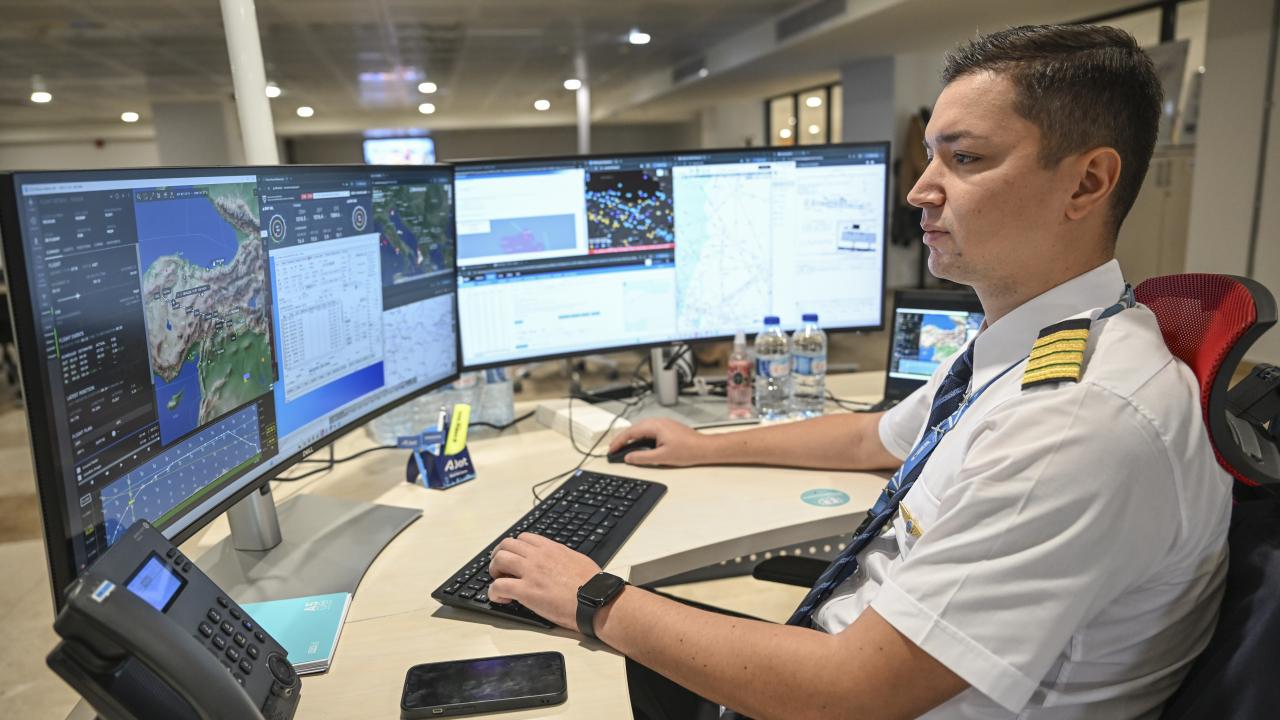
Operating an airline requires licensed pilots, flight dispatchers and technicians, cabin crew, certified ground operations officers and loadmasters.
Although pilots and cabin crew are well known to the public, flight dispatchers have an important role in aviation.
Dispatchers, who ensure effective continuity of a flight from start to finish, monitor the flight to relay information about the flight to the necessary units and control the process by reporting emergencies such as sabotage, accidents and hijackings to the necessary units.
Dispatchers, who make all the necessary preparations for the healthy and economical operation of a scheduled airline flight, experience the respective flight virtually and take precautionary measures for any problems that may arise. While the captain is only responsible for his own flight, the dispatchers perform superhuman performance on all aircraft and flights in the fleet.
Additionally, dispatchers prevent financial losses by working to reduce costs for the company with every flight plan they create.
On the occasion of December 7th, International Civil Aviation Day, the dispatchers working at AJet explained the details of their job.
“We prepare flight plans before the captains arrive on the plane.”
AJet's flight operations manager Orhan Atmaca stated that he has 23 years of experience in aviation and explained that all flight plans are prepared by them so that passengers can get from point A to point B safely.
Pointing out that they submitted the plans they had prepared to the captains in the form of a flight package, Atmaca said: “Before the captains arrive on the plane, we prepare a flight plan after compiling all relevant airports, weather conditions, passenger and weight information,” he said.
Stating that they consider passengers as guests and aim for a safe and comfortable journey, Atmaca said: “For example, on the flight from here to Berlin, turbulence of about 35,000 feet was expected on the Central Europe line. We planned our aircraft at the optimal level and climbed to 37,000 feet, and our passengers were not affected by this turbulence.” he said.
Atmaca continued in his speech by discussing the reasons for aircraft delays:
“We are the people that passengers are most annoyed with when there are delays. We make the necessary delays for the safety of the passengers and the safety of the flight. The destination airports have a system to ensure a safe landing. After these systems, we have the weather conditions that we follow. In order for the plane to descend, it must be able to see the vertical view of the cloud and the runway where it will park horizontally. If these are not suitable, the plane may crash. By checking the weather reports we contact the meteorological units “We can postpone or cancel the flight if the runway is not suitable due to snowfall.”
Atmaca pointed out that very cold, stormy and snowy weather, as well as very hot weather, cause problems in flights, saying that on flights such as Jeddah and Medina, weight restrictions may be introduced to allow planes to take off safely, and in rare cases, suitcases and luggage will be unloaded.
“It takes someone to manage the operation in all sorts of extreme situations.”
Atmaca stated that at certain times they participated in the flights as observers along with the pilots and were able to test whether their planning, routes and fuel calculations were appropriate on these flights.
Stating that his profession was not well known, Atmaca said: “In 2007, we asked about my wife. They asked, 'What do you do?' “Are you a pilot?” No. “Do you work in the tower?” No. “What are you doing?” they said. At the time, I thought that the profile of our profession needed to increase. “We trained friends and industry initiatives to do this.” he said.
Atmaca explained that the aviation kitchen is the dispatcher and operational control unit: “We are the headquarters of an airline. In this headquarters, we are the brains and heart of relevant aviation flight operations. We are the eyes and ears of our captains in the air so that flight operations can continue.” he said.
Stating that he loves his job very much, Atmaca said: “It is a stressful job. When time is of the essence, you stay away from your spouse and loved ones. It takes someone to run the operation in all sorts of extreme situations. We have been here and will continue to be here to ensure that flights continue to operate safely even during earthquakes, wars and coup attempts.” he said.
“As a dispatcher, I became more involved as a flight enthusiast.”
AJet's Operational Safety and Efficiency Head Doğuş Suray Kara stated that he investigates the safety incidents in the airspaces to be covered before flights. If there is a situation that negatively affects the flight, he organizes the routes and meets with the captain to ensure that the flight is carried out safely.
As examples of his work, Kara said: “As you know, partial wars can occur in the Middle East. We create a safer and more economical flight plan by avoiding these routes according to the published airspace information. Therefore, as part of safety, changes are made in the flight duration, even if the passengers do not notice it. For example, if there is a situation between point A and point B, we make sure that they fly to these points on a different route.” he said.
Kara explained her interest in the profession by saying, “Previously, I worked as a flight attendant. After two years, I discovered the dispatcher profession, which is the cornerstone of aviation operations, and moved here. It is generally a very unknown profession, but when you know it, it is a profession that is as passionate as we are. The profession of a flight attendant and the profession of a dispatcher are completely different from each other. Since the profession of a dispatcher is more in the business field I got more involved in the job as an aviation technician.” Enthusiast. He explained it with his words.
Kara said that when he talks about his job with the people he meets, he is not understood and is often confused with the tower and cockpit crew, and that they are accepted as cockpit crew by people who do not understand them.
Kara said he wanted to continue working as a dispatcher in the aviation industry, adding that the job was a career opportunity for graduates and students.
Bir yanıt yazın