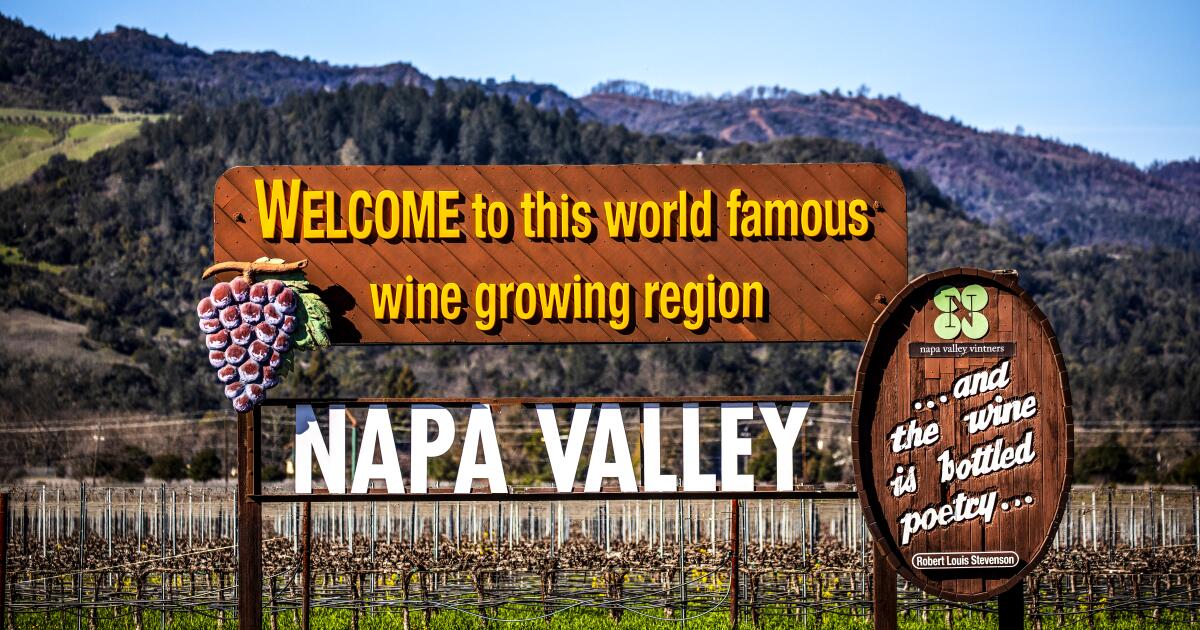
Highway 29 winds along the Napa Valley through Yountville and St. Helena and up to Calistoga, past vineyards that produce some of the world's most famous and expensive wines.
The road, lined with rows of vines planted along sun-drenched hills, is simply famous for its breathtaking beauty – and the staggering number of Michelin-starred restaurants, spas and boutique inns that have popped up among the vineyards.
And lately, for locals anyway, it's also the source of a pressing mystery: Why were so many of the fancy wineries along this road — and their rich and powerful owners — named in federal subpoenas served in Napa County late last year? ?
“Please produce all documents relating to the following persons, companies and/or projects,” one subpoena reads, before drawing up a list that reads more like a high-end tourist brochure than what one would normally find in found in a court file.
Among the glittering names whose county records are sought Hall winesknown for its bold Cabernets and luxurious St. Helena winery with a towering statue of a silver rabbit. Kathryn Halla former US ambassador to Austria, is also named, as is her husband, Craig Halla former partner of the Dallas Cowboys whose art collection is so valued that parts of it were loaned to the Jeu de Paume art center in Paris.
Caymus vineyardswhose Cabernet is a frequent favorite Wine spectatorand owner Charles J. “Chuck” Wagner are listed in the records request, as are Wagner’s son Charlie Wagner and his vineyard. Mer Soleil.
The list of luminaries continues: Robin Baggett, a former general counsel for the Golden State Warriors, and his Alpha Omega Winery. Dave Phinney, whose Prisoner label changed the industry. Grant Long Jr. and his wineries Aonair and Reverie II. Jayson Woodbridge and Hundred Acre. Darioush Khaledi and his winery of the same name. And on it goes – a total of 40 people and companies, including Napa's exclusive Meritage Resort and Spa.
The subpoena seeking records relating to the wineries and their owners, dated December 13, 2023, is filed under the name of Patrick Robbins, First Assistant U.S. Attorney for the Northern District of California. It also refers to an FBI agent, Katherine Ferrato, who has experience solving complex financial crimes.
Separately, a litigator working in the Justice Department's antitrust division filed a subpoena dated December. 7, requesting records from the Upper Valley Waste Management Agency, a joint powers agency that manages trash and recycling services for Calistoga, St. Helena and Yountville. A third subpoena seeks records about the Napa County airport, which local officials want to modernize. A fourth was appointed to the county agriculture department, which has become an influential political voice on behalf of wineries in recent years.
If Napa County officials have any idea what's going on, they're not telling. “Napa County is not under investigation,” county spokeswoman Holly Dawson said. “We were issued a subpoena to inspect the files. We don’t know anything more.”
The U.S. Attorney's Office in San Francisco declined to comment, as did the FBI office in San Francisco.
Some of the people named in the investigation did not respond to interview requests. Some who responded said they were perplexed.
Craig and Kathryn Hall issued a statement through their PR director: “We are aware that there is an ongoing investigation. However, we do not know the scope or details and it would be inappropriate to speculate,” the couple said.
Alpha Omega's Baggett said his operations have “nothing pending” before the county and therefore “zero” documents that have been turned over. He said it was “a huge waste of time to explain every day that we did nothing wrong.”
Baggett dismissed the investigation as a “fishing expedition” or worse, adding: “I hope it's not a political witch hunt.”
Baggett, like several respondents, speculated that a person of interest could be Napa County Supervisor Alfredo Pedroza, who has drawn ire from local environmental activists because he is seen as a pro-agriculture advocate, which in Napa Valley almost always means a pro-wine farm.
Some of the companies whose records were subpoenaed have donated to Pedroza's political campaigns. A small group was involved in a controversial land deal involving Pedroza's family, adjacent to a property the Halls wanted to develop in the eastern hills of Napa Valley.
Craig and Kathryn Hall had been trying for years to establish a 208-acre vineyard at Walt Ranch, 2,300 acres of oak forest they owned in Napa's Atlas Peak appellation and prized for its elevation and rich volcanic soil. The property was undeveloped when the Halls purchased it in 2005, but was zoned agricultural. Their efforts to clear space for a vineyard faced fierce opposition from environmental groups who said it would endanger oak trees and wildlife habitat, deplete limited water supplies and increase the risk of fire.
After years of regulatory and legal disputes, the development was provisionally approved by the Supervisory Board at the end of 2021. Pedroza voted for the project.
His voice sparked a new controversy when a local activist, documentary filmmaker Beth Nelsen, discovered that Pedroza's father-in-law had purchased property next to the planned vineyard. The San Francisco Chronicle followed with reports that Pedroza and his wife helped secure a loan for the purchase, using his Napa home as collateral. Critics said that the Walt Ranch development would undoubtedly increase property values in the area – including the property purchased by Pedroza's father-in-law – and that Pedroza should have publicly disclosed his involvement as a conflict of interest.
Pedroza denied having a financial interest in the property but recused himself from subsequent votes on Walt Ranch.
In late 2022, the Halls abandoned the idea of developing the vineyard and worked out a contract to preserve the land through the county land trust.
According to the Napa Valley Register, the FBI searched Pedroza's home in December. He has decided not to run for another term on the board and will complete his term later this year.
Pedroza did not respond to calls and emails seeking comment from The Times. Earlier this month, he sent an email statement to the Santa Rosa Press Democrat: “I believe that everyone should cooperate fully with all branches of federal and state government, and I always support the citizens of Napa and all public agencies in Napa encouraged to do this. “There is no reason to do anything else.”
Adding to the intrigue — and sadness — a key figure in Napa County, Ryan Klobas, died in January by apparent suicide, weeks after the Justice Department served a subpoena to the Napa County Farm Bureau, which Klobas ran. Klobas joined Farm Bureau as policy director in 2017 and was named chief executive in 2018. Under his leadership, the Bureau doubled its membership and formed a political action committee that worked on behalf of the Bureau and raised funds to successfully defeat a county initiative that would have limited winery growth.
The bureau's interim CEO, Tawny Tesconi, confirmed that the bureau had received a subpoena but declined any further comment.
As the mystery unravels, one thing is clear: The federal investigation comes amid a bitter disagreement between longtime winemakers and residents over the future of Napa Valley. Should the valley continue to add vineyards? Or has the proliferation of wineries, tourists and traffic reached a tipping point that threatens to erode the natural surroundings and rural charm – no matter how beautiful the rows of grapes are in the slanting afternoon light?
“Our entire economy depends on the success of our agriculture, our wine and our hospitality,” said former Yountville Mayor John Dunbar, a wine industry supporter. But the fight over land use has become “toxic,” he said. “People are attacked because they are for or against a wine-growing permit.”
Geoff Ellsworth, a former mayor of St. Helena, is among those who believe the forces of development pose a grave threat to the valley's environment and are leading to political corruption. Additionally, he fears the influx of hotels and tourist attractions will “hollow out” his hometown and others on the valley floor.
Ellsworth, who grew up in St. Helena and returned about a decade ago after years in Los Angeles, said a turning point for him was when he learned of a proposal to redevelop St. Helena City Hall was converted into a hotel and tiered water rates were eliminated. “I thought, 'Wait a minute,'” he said. Soon after, he decided to run for city council and eventually became mayor.
And then he heard about problems at the landfill in the hills above Calistoga, which takes in the trash from many wineries as well as trash from surrounding counties. “Fires,” he said. “Radioactive waste. “I'm the mayor and I'm wondering what's going on?”
Ellsworth eventually joined forces with another citizen concerned about the landfill: Anne Wheaton. Now a couple, they have devoted the past few years to uncovering what they say is a complicated web of environmental and workplace safety violations that they fear could make the landfill dangerous.
By the end of 2020, Ellsworth said, he was so outraged that he contacted the Justice Department. He and Wheaton were pleased to read the subpoena the department filed with the county asking about its dealings with the Upper Valley Waste Management Agency. Information is sought on contracting and communication between authorities and elected officials.
Ellsworth said he was not aware of the scope or details of the federal investigation, nor what role the landfill might play. But he believes powerful interests have a stake in the outcome — so much so that he and Wheaton have left the county.
“Billions of dollars are at stake here,” Ellsworth said. “We wanted to distance ourselves from the situation.”
Bir yanıt yazın