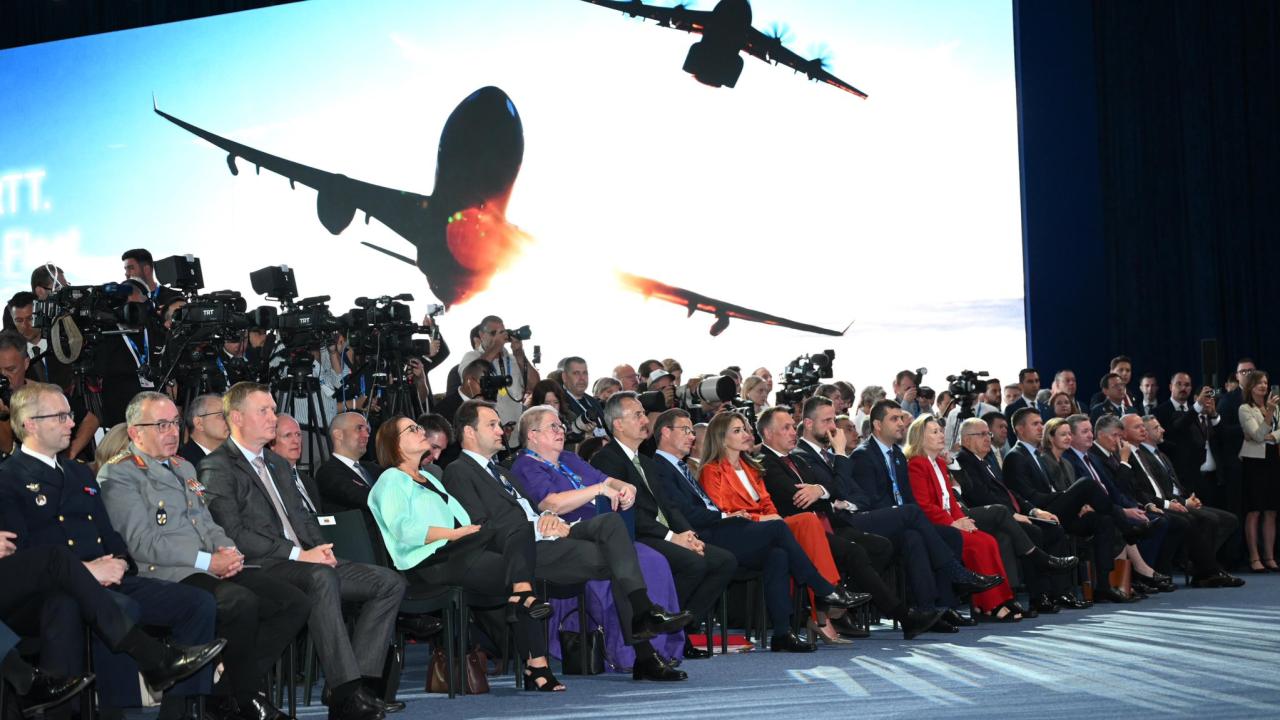
NATO Deputy Secretary General Radmila Shekerinska spoke about NATO's new projects in the areas of “Space and Surveillance”, “Offensive Capabilities” and “Integrated Air and Missile Defense” at the Defense Industrial Forum in Ankara as part of the 36th NATO Summit of Heads of State and Government.
Presenting NATO's space and surveillance projects, Shekerinska said: “This is part of our critical infrastructure, but also crucial for our security. Without space-based capabilities, our armies would not function properly today. Space technology has become more affordable and launch costs have increased significantly. As a result, more and more countries are investing in their own satellite networks.” he said.
Shekerinska said she was very pleased to announce that a project has been launched to study the development of a group of satellites called “Halo”, saying: “This opens a new page in Allied space operations. Therefore, this new model will provide great advantages, especially in the areas of high-speed communications, reconnaissance and missile tracking, by overcoming the limitations of a single country's satellite fleets in terms of cost, time and coverage.” he said.
Informing about the initiative in the field of space-based intelligence, Shekerinska said: “This is the project called 'Alliance Continuity Surveillance from Space (APSS).' This initiative was launched two years ago at the Washington Summit and today Spain will be the 19th country to take part in this initiative.” he said.
Regarding Türkiye's plan to develop two new high-resolution satellites, Shekerinska said:
“These satellites will be built here in Türkiye by the TUBITAK Space Institute for a contract fee. Turkey has also signed contracts with ASELSAN for the supply and development of early warning radar systems within the framework of the 'Steel Dome National Integrated Air Defense', as well as the development of low-orbit satellites and military communication systems. These systems will enhance Türkiye's ability to maintain connectivity on the battlefield as well as its detection and early warning capabilities.”
Shekerinska also explained that work is underway on the “Starlift Initiative,” which aims to create a network of launch companies and spaceports that will be used to launch a replacement satellite into orbit in an emergency.
“With these initiatives we can significantly increase our production.”
Referring to NATO's “offensive capabilities” projects, Shekerinska introduced the “Ground-Based Precision Strike Project,” created to develop and deliver large-scale low-cost cruise and ballistic missiles.
Regarding the development of another initiative, the ammunition prototype, Shekerinska said: “The host country Türkiye has also committed to supplying a significant number of long-range ground-launched cruise missiles of the ATMACA type.” he said.
“These initiatives will help ensure that our production actually increases significantly and that our armed forces have everything they need to ensure our security,” said Deputy Secretary General Shekerinska. he said.
“(Air defense systems) All of this is necessary to keep our airspace safe and maintain deterrence and the credibility of our defense forces.”
Referring to NATO's Integrated Air and Missile Defense projects, Shekerinska described these systems as NATO's “front line of defense” and said:
“In recent months, we have seen repeated airspace violations by Russian drones and Russian aircraft. In addition, NATO has successfully intercepted ballistic missiles fired by Iran at our ally Türkiye. Therefore, we need more of them to ensure the safety of all of us.” he said.
“To achieve this faster and better and to integrate the latest technologies into our capabilities, we must pool all our resources and conduct these studies together. All of this is necessary to keep our airspace safe and maintain the credibility of our deterrence and defense forces,” Shekerinska said. he said.
Stating that they have demonstrated their resolve on the projects in question, Shekerinska said: “Our allies have begun to effectively deploy additional defense spending. We have achieved this through an impressive series of announcements and contracts that we have made to ensure competence in a wide range of and truly critical areas.” he said.
After Shekerinska presented the new NATO projects in the areas of “Space and Surveillance”, “Offensive Capabilities” and “Integrated Air and Missile Defense”, a mass signing ceremony was held.
Bir yanıt yazın