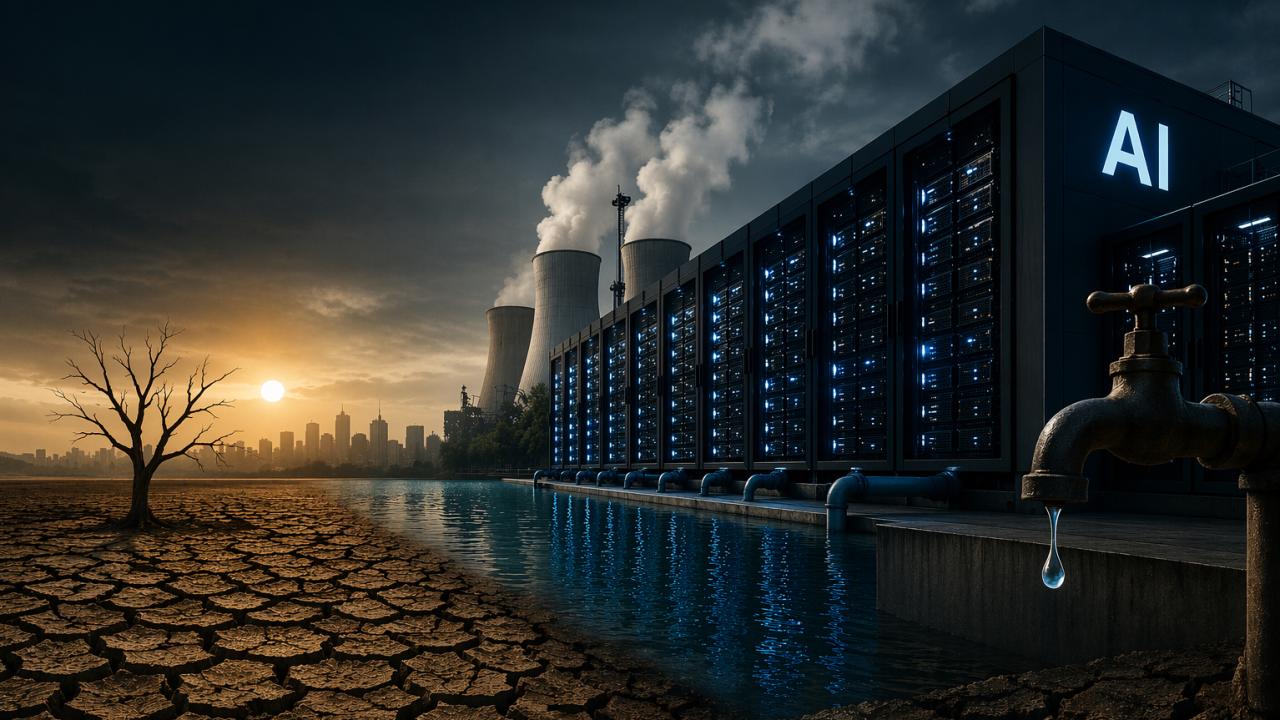
The digital revolution caused by artificial intelligence systems also leads to a large consumption of natural resources. Data processing processes now not only consume energy, but also more intensive cooling and therefore more water compared to conventional cloud computing systems.
The fact that global tech giants turned to Southeast Asia to set up data center bases has pushed the region's “digital thirst” to critical levels.
According to the latest data, installed data center capacity in the region was 10 megawatts in 2021, increasing to 1.3 gigawatts by 2024.
Analysis shows that data center energy needs could reach almost 6 gigawatts by 2035.
Research warns that global water demand driven by artificial intelligence could reach 6.4 trillion liters in 2027, and suggests that digital transformation could dry up local resources if water efficiency is not achieved.
Singapore's restrictions have shifted investment to neighboring countries
As pressure on resources increased, local governments changed their strategies.
The Southeast Asian nation of Singapore has tightened regulations on data center projects to conserve limited resources, changing the regional investment landscape.
These countries faced a similar sustainability crisis as tech giants shifted their investments to Malaysia and Indonesia.
The Johor region of Malaysia has quickly become the world's fastest-growing data center market, attracting billions of dollars in investment. However, in some regions the daily water consumption of these systems now exceeds the total needs of thousands of households.
The state government rejected 30 percent of applications for new data centers in 2025, citing a lack of infrastructure and water security. New projects have been mandated to use recycled water and liquid cooling technologies instead of drinking water.
The disruption of the balance between economic returns and environmental costs in the region also paved the way for protests involving the local population starting in February 2026.
The risk is greater in hot climates
Dr. from the University of California, USA. Shaolei Ren pointed out in his statement that cooling needs largely depend on local weather conditions and the operating settings of the cooling system.
Ren pointed out that this demand could increase even more in hot climates such as Southeast Asia, explaining that per-unit water consumption could be higher in these regions compared to regions with colder climates.
“Compared to colder regions such as Northern Europe, data centers in warm environments often require significantly more cooling throughout the year, which can result in higher water consumption when using evaporative cooling,” said Ren. he said.
Emphasizing that as artificial intelligence models become more complex, cooling needs may also increase, Ren emphasized that liquid cooling technologies are promising as they can significantly reduce the use of evaporative water.
“Liquid cooling technologies can increase efficiency while reducing reliance on fresh water for cooling.” Ren explained that the evaporative cooling method still remains the most efficient cooling tool for many regions, especially in hot climates.
It is easier to talk about economic benefits than environmental factors
Ren explained that many technology companies express the economic benefits of setting up data centers in Southeast Asia because it is easier to address the issue from an environmental perspective.
Ren noted that the impact of water infrastructure on watershed pressure and long-term resource planning is still being debated in many regions, saying more precise data on the issue is needed.
“While most companies report global or enterprise-wide water metrics, they rarely disclose operational-level data or region-specific data, making it difficult for communities to understand local impacts,” Ren said, pointing out that water needs are not being adequately discussed in regions where there are already water shortages. he said.
Bir yanıt yazın