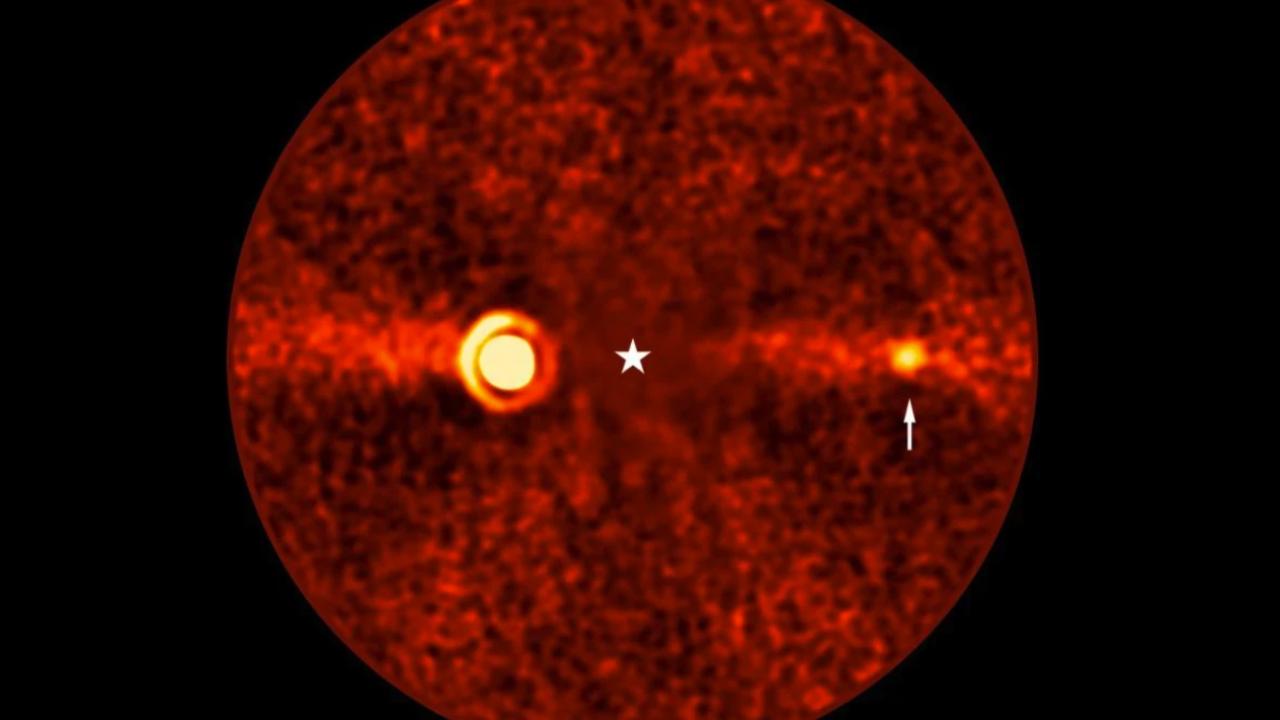
The tradition that many important discoveries in the world of science occurred by chance also manifested itself in space exploration. Astronomers discovered a third planet during their observations, the existence of which has not yet been confirmed, in order to study the temporal changes of an already known planet in the Beta Pictoris star system.
This new celestial object, called Beta Pictoris d, has not yet been discovered because it was hidden in the strong light of its own star. Recent research has shown that this planet is the faintest exoplanet that can be photographed directly from Earth.
Baby planet between dust clouds
Beta Pictoris is located about 64 light-years from Earth and, in astronomical terms, is considered a very young star with an age of about 23 million years.
Almost twice as massive and nine times brighter than the Sun, this star is surrounded by giant disks of dust and debris from which planets form.
“Beta Pictoris d” is the third directly imaged member of this system, following two previously discovered extremely hot giant gas planets in the system with a mass about ten times that of Jupiter.
The world hidden in the shine of the star
This newly discovered planet has very different properties compared to its other larger siblings in the system. Beta Pictoris d has a mass about 2.4 times that of Jupiter and has a much colder structure than the others, with a temperature of about 330 degrees Celsius.
The delay in discovering the planet and the difficulty of imaging it directly are due to its distance from the star to which it is attached. Orbiting very far around its star, the planet was lost in the blinding glare of the parent star, whose light was 100 times fainter than that of Beta Pictoris b, the first known planet in the system.
Astronomers managed to overcome this obstacle by capturing images extremely quickly using advanced telescope technologies.
It will shed light on the future of planetary systems
Systems in which more than one planet can be directly imaged in the same formation environment serve as astronomers' laboratory of the universe.
Such multiple systems are of great importance for understanding how different planets adopt different structures under the same conditions.
Scientists predict that much smaller and fainter worlds hidden in these systems will be discovered thanks to new-generation observatories such as the Extremely Large Telescope, which will be operational in the future.
Bir yanıt yazın