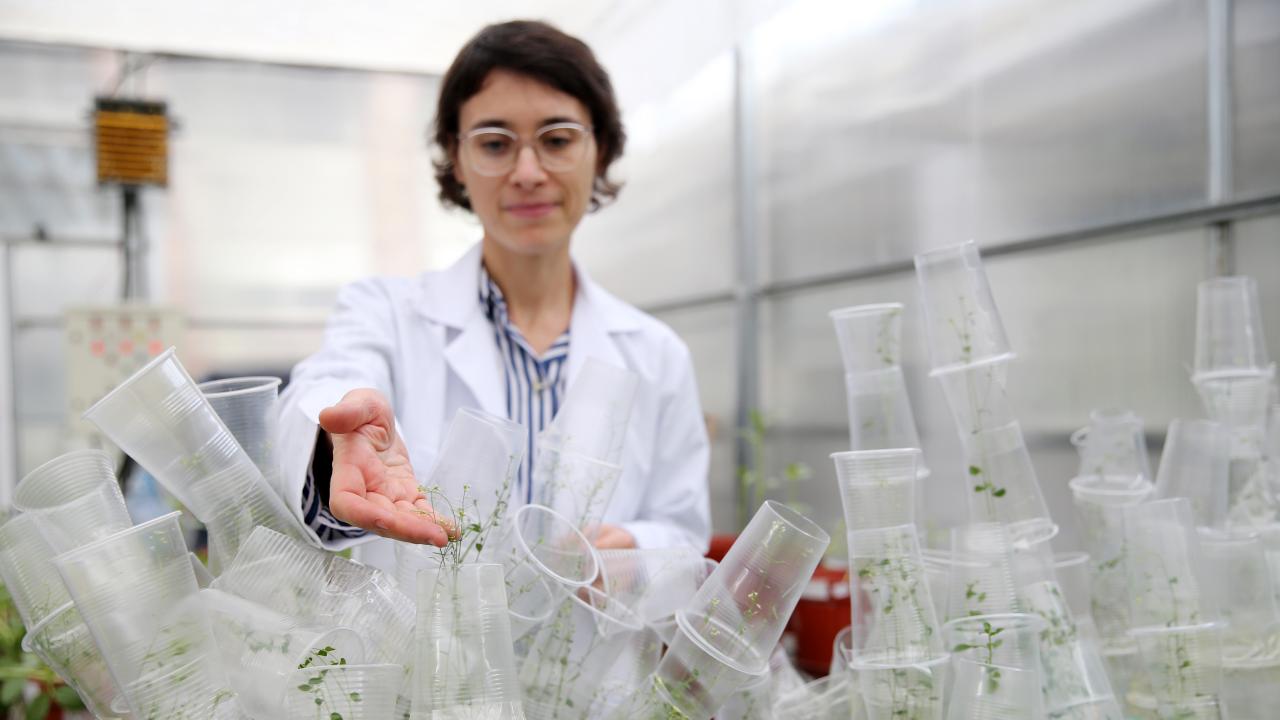
Uzilday graduated from Ege University, Faculty of Science, Department of Biology in 2006 and completed his master's degree at Kumamoto University, Department of Biology, Japan.
Uzilday returned to Ege University in 2010 and began his doctoral studies. The scientist, who studies in the field of plant molecular biology and plant physiology, worked as a researcher in the microgravity laboratory of Tohoku University in Japan in 2021.
Türkiye bears his signature on his first experiment in space
Uzilday, who is involved in TÜBİTAK's studies in the field of space biology, works with her husband Assoc. Prof. in the same department. Dr. He was among the leaders of the first experiments of Barış Uzilday and the first Turkish astronaut Alper Gezeravcı on the International Space Station.
The experiment, titled “Investigating the Responses of the Extreme Halophyte Schrenkiella Parvula to Salt Stress in a Space Environment,” examined plants exposed to salt stress.
The color continued after Özgür Uzilday's studies in space biology. Uzilday sent Arabidopsis plant seeds (Phenomenon) into space with the Chinese Space Agency's “Shijian-19” satellite as part of studies to develop varieties resistant to diseases and environmental stresses under the coordination of the Turkish Space Agency.
Focus on plant cultivation in weightlessness
Assoc. Dr. Rengin Özgür Uzilday said that his work focuses on growing crops in zero gravity conditions and developing resistant species.
Uzilday explained that he is conducting plant cultivation projects using regolith (dust, soil, broken rock and similar materials) similar to the soil of the Moon and Mars, and explained that he is researching plant species that are more resistant to the specific conditions of the space environment.
Uzilday: “Can species that grow on Earth under extreme conditions also grow in space?” They conducted laboratory studies and experiments to answer the questions: “We make the data we obtained available to scientists working in the field of agricultural biotechnology.” he said.
Contribution of space recovery to the world
Explaining that space breeding studies also contribute to agricultural production in the world, Uzilday explained that natural mutations occur in the seeds sent into space without using an external source of radiation.
Explaining that this method does not require removing radioactive waste from the seeds, Uzilday said: “We get cheaper mutants, very inexpensive, and then we carry out studies on whether the species we obtained can grow in better conditions in the world, whether they are more resistant to drought and more resistant to heat, and whether plants can be grown in conditions that cannot grow.” he said.
Addressing a message to female students on the occasion of February 11, the International Day of Women and Girls in Science, Uzilday concluded his remarks as follows:
“In addition to the things waiting to be discovered on Earth, there are also many things waiting to be discovered in space. Therefore, the more female students working in laboratory studies and biology-related courses, the better. I hope our work will be inspiring.”
Bir yanıt yazın