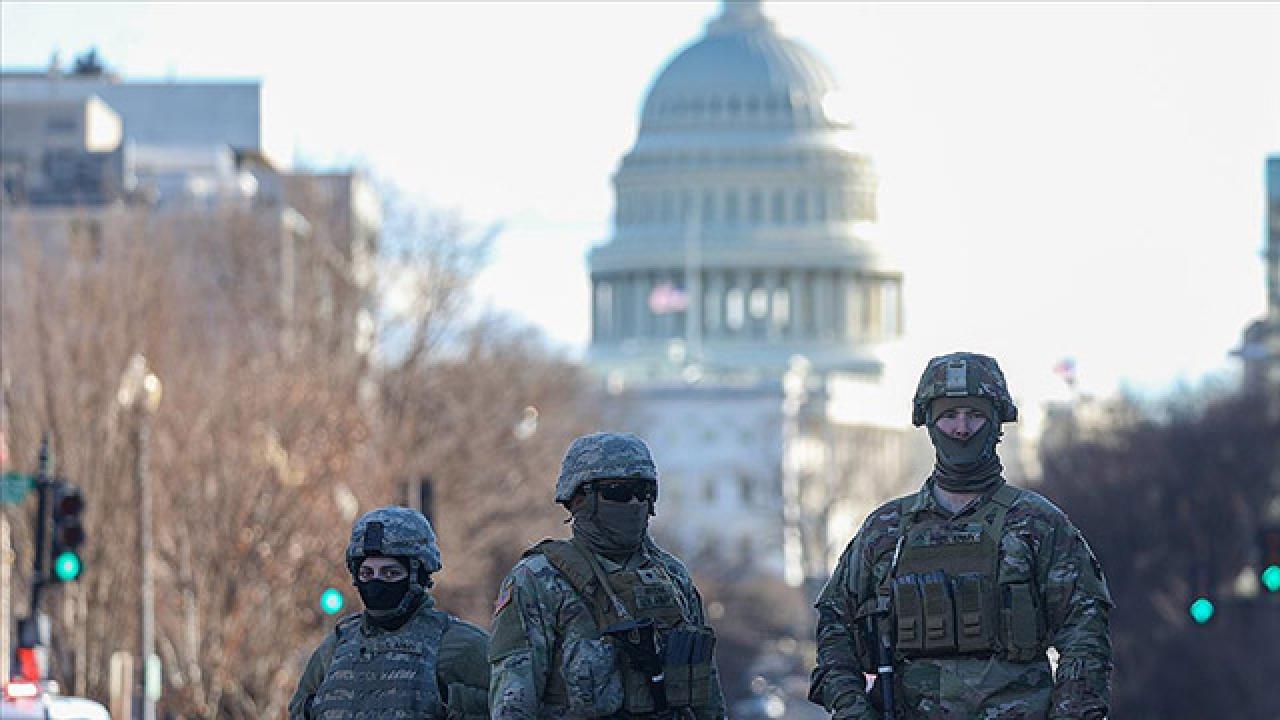
The attack in which two National Guard soldiers were shot yesterday in Washington, the US capital, was described as a “terrorist act” and brought the history, functioning and structure of the National Guard to the forefront.
It was reported that yesterday two National Guardsmen serving in an area near the White House were shot and the suspect was captured. Federal Bureau of Investigation (FBI) Director Kash Patel described the incident as a “matter of national security” in his statement.
Washington Mayor Muriel Bowser also said they would thoroughly investigate the incident, which she described as a “targeted attack.”
US President Donald Trump said in his statement that the attacker, whom he described as an “animal,” would “pay a heavy price.” Trump indicated that they viewed the incident, which he called a “hateful act,” as a “terrorist attack.”
US President: “America will never bow or capitulate in the face of terrorism.” He said he had ordered the Pentagon to send an additional 500 National Guard troops to Washington.
The incident sparked curiosity in the international community about the National Guard's history, operations, troop levels, budget and administration.
Former US Army troops
These units, whose origins are based on colonial-era American militia forces, are based on the tradition of a “citizen-military organization” with a shared civil-military defense vision.
Military units, whose founding dates back to the 17th century and whose official founding day is December 13th each year, have the motivation “civilian in peace, soldier in war”.
The units are considered to predate the U.S. Army, which was founded in June 1775, a year before the Declaration of Independence in 1776.
The Guard evolved from an “organized militia network” in the early 20th century to a well-equipped and organized force today under the Militia Act of 1903, known as the “Dick Act.”
The troops consist of two parts: the Ground National Guard (ARNG), founded in 1636, and the Air National Guard (ANG), founded in 1947.
The Guard is defined as a component of the U.S. Army and U.S. Air Force and is defined as a military reserve element at the state and federal levels.
Commander in Chief: President of the United States
When activated for federal missions, the Guard becomes “serving reservists” of the U.S. Army and U.S. Air Force.
The President of the United States is the commander in chief of the military, whose history goes back almost 400 years and whose motto is “always ready, always there.”
The Guard is administered by the Virginia-based National Guard Bureau, which is affiliated with the United States Department of Defense (Pentagon).
The office, headed by a four-star general in the U.S. Army or Air Force, ensures that units communicate with the Pentagon.
“Unique power” at the federal and state levels
Maj. Gen. Roger Schultz, who led the ANG from 1998 to 2005, said in a report on the National Guard during his tenure that the troops maintained their “unique status” as both a federal and state force.
“As a federal reserve force on the first line of defense, the Army National Guard provides ready forces for mobilization in times of war and national emergencies. As a government force, it protects life, property and public safety,” Schultz wrote in his report. he said.
Domestic and international assignments
In the USA, the troops are a special unit of the US Army that reports to both the state governors and the US President.
As a “strategic reserve,” the National Guard plays an important role in national and international operations.
The Guards perform duties in areas such as disaster relief, military assistance, law enforcement, border security, election security and some state-level military cooperation.
Troops capable of deploying abroad were recently able to conduct the Pentagon's critical military intelligence analysis, including in Ukraine and the Middle East.
According to fiscal year 2023 data, troop strength is approximately 430,000, including 105,000 airmen and 325,000 soldiers.
The National Guard is funded annually from the federal government's budget.
The FY2024 federal budget allocated $9.7 billion for ARNG and $5.2 billion for ANG.
By regulation, members of the National Guard commit to participating in one training weekend per month and at least a few weeks of service per year.
Most ARNG and ANG members are known to hold full-time civilian jobs in addition to serving in the National Guard in the states where they live.
First “operation without the approval of the governor” in 60 years
Guardsmen, often appointed by respective state governors, may also in some cases be appointed to federal service by the U.S. President.
Within the country, state-level missions typically last less than three months, while federal-level missions typically last at least a year.
Presidents rarely assign federal duties to a state or territory's Guard without the approval of the state's governor.
In June of this year, US President Trump bypassed California Governor Gavin Newsom and deployed guards against immigration protests in Los Angeles.
Trump's decision to send around 4,000 guards to the region was recorded 60 years later by a US president as an “operation without the consent of the governor”.
Current dates
In rare cases, U.S. presidents can use the military or National Guard to mobilize during times of domestic rebellion or unrest.
National Guardsmen are capable of restoring peace in the areas where they are deployed following violent interventions by local law enforcement or incidents of unlawful violence.
However, unions have sometimes been known to increase tensions against communities and people protesting for civil rights or racial equality.
In 1992, a black driver rioted in Los Angeles after the acquittal of white police officers who allegedly severely beat Rodney King.
The protests, in which 63 people died, were among the deadliest events in American history. Nine of the protesters were killed by police. US President George HW Bush, who served from 1989 to 1993, commissioned the National Guard.
At the end of 2005, Hurricane Katrina caused 1,392 deaths and $125 billion in damage, primarily in the city of New Orleans and the surrounding area. Nearly 50,000 National Guard troops were deployed to the region to respond to the natural disaster.
In 2020, as the COVID-19 epidemic spread and racist protests were widespread, nearly 100,000 National Guard troops were deployed to various parts of the United States.
In the US, around 8,000 National Guard soldiers were deployed to quell protests against racial injustice in Los Angeles after the black American George Floyd died as a result of police violence in Minnesota in 2020.
Bir yanıt yazın