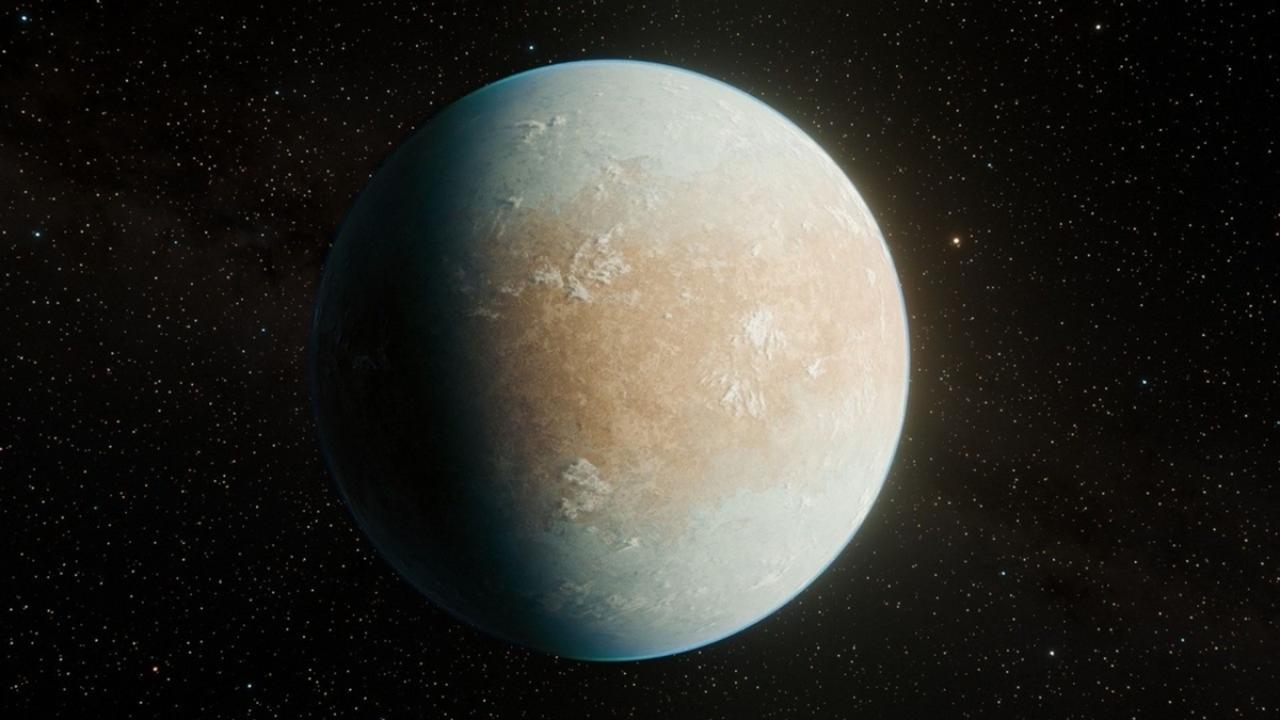
Astronomers announced that they have found a candidate “exoplanet” about 150 light-years away that is structurally very similar to Earth but quite cold. This new world, discovered using data from NASA's retired Kepler space telescope, caused great excitement in the scientific world.
The planet, called HD-137010 b, is about 1.2 times heavier than Earth. Its most striking feature is its orbital period: this planet completes its orbit around its star in 355 days. A year in this distant world is almost as long as ours.
Researchers calculate a 51% chance that the planet is in its star's “habitable zone” (the distance at which liquid water can be found). However, since the energy it receives from its star is less than a third of that received from Earth, the surface temperature is estimated to be -68 to -85 degrees. This makes the planet even colder than Mars.
“Snowball” scenario and probability of survival
According to scientists, the planet may be in a “snowball” phase, where it is completely covered in ice. However, when there is abundant carbon dioxide (CO2) in the atmosphere, the resulting greenhouse effect can increase surface temperatures and allow liquid water to exist. This does not mean that life is completely impossible, as the Earth has gone through similar “snowball” phases several times in its geological history.
Further observations are needed to confirm the planet's existence. Experts say this discovery represents an important milestone in our technology for discovering Earth-like planets. New generation telescopes such as PLATO from the European Space Agency (ESA) will be used for future observations.
Bir yanıt yazın