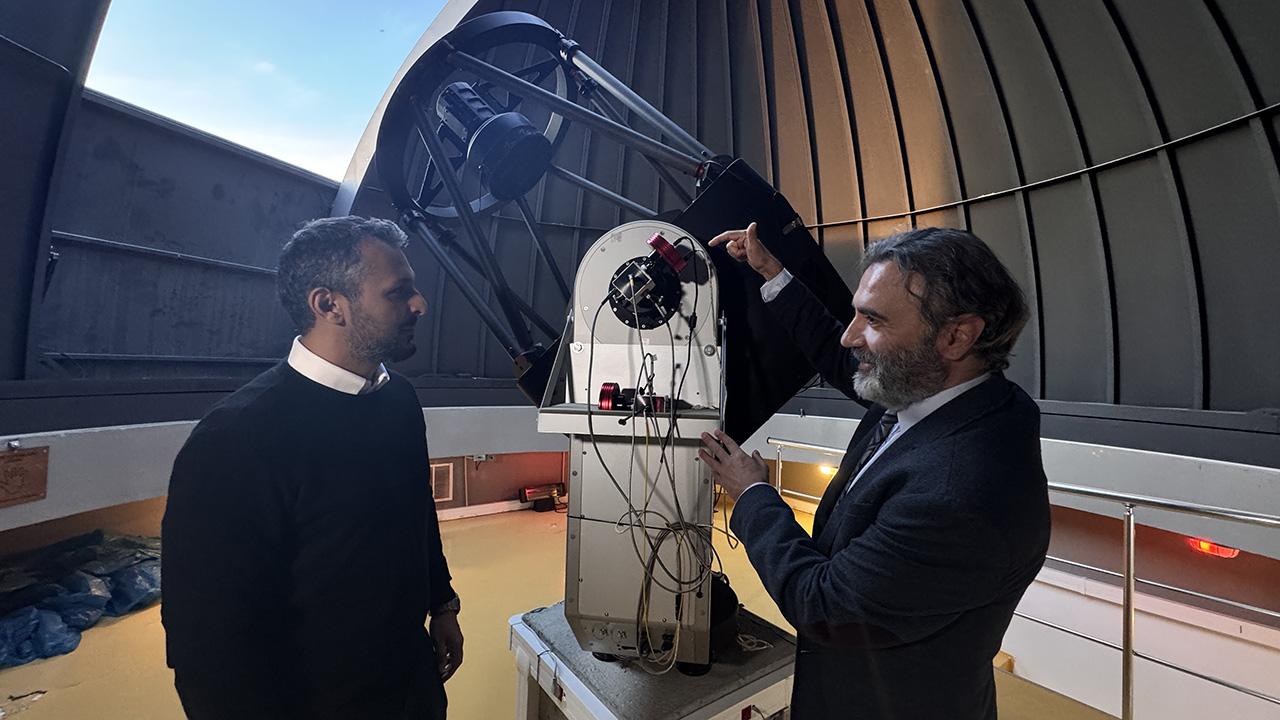
The results of the research “Discovery and Characterization of Super-Earth and Mini-Neptune Type Exoplanets” as part of the dissertation of Selçuk Yalçınkaya, a doctoral student of the Institute of Science of Ankara University (AÜ), Department of Astronomy and Space Sciences, were published in “Astronomy & Astrophysics”, one of the most prestigious journals in the field of astronomy.
Yalçınkaya, who was funded under the “TÜBİTAK 2214-A International Doctoral Research Scholarship Program,” carried out some of his graduate work at the University of Liège in Belgium.
Continuing his studies here and in Türkiye, Yalçınkaya, with his team of international astronomers, including a Nobel Prize-winning scientist, discovered four exoplanets for the first time, two around the smaller and cooler star than the Sun “TOI-5799” and one each around the stars “TOI-1743” and “TOI-6223”, using the “transit method” often used in planet discovery.
The study, which used telescopes from the AÜ Kreiken Observatory (AUKR) and the Turkish National Observatory (TUG), found that “TOI-5799c”, one of the exoplanets discovered around the star “TOI-5799”, about 90 light-years away, was located at the inner limit of the star's habitable zone.
In this context, the possibility that the exoplanet has an atmosphere due to its location in the habitable zone highlights the possibility of observing signs of life with the James Webb Space Telescope (JWST).
“About 70 percent larger than Earth and a terrestrial planet”
Yalçınkaya said that the exoplanets discovered in the study are “candidate exoplanets” based on previous studies by the TESS Space Telescope.
Yalçınkaya explained that the telescope is looking for a “transition signal” for 30 days based on the light losses caused by the exoplanet candidate stars in space: “Then we observe which star in this region this transition signal comes from with telescopes around the world, such as the 80 centimeter telescopes in our observatory, and determine whether this signal really comes from the star there or comes from another star next to it. Then we carry out different types of tests.” Observational experiments to determine whether this signal is coming from. “We explore its nature and that’s how we make the discovery.” he said.
Yalçınkaya stated that they continue their work with telescopes in AUKR and TUG, as well as with telescopes in different countries, and that they have carried out some of the work abroad with the support of TÜBİTAK.
Yalçınkaya stated that as a result of the studies, they discovered four exoplanets, two in the star “TOI-5799” and one in the stars “TOI-1743” and “TOI-6223”.
“One of them, 'TOI-6223b', is a planet the size of Neptune, but very close to its own star. Therefore, it is a planet called Hot-Neptune. It is similar to Neptune in radius, but we don't yet know if it is actually similar. To do this, you have to look at what gases it has in its atmosphere. The other planet, 'TOI-1743b', is a super-Earth type planet. It is about 70 percent large larger than Earth and probably a terrestrial planet. “It cannot retain volatile gases in its atmosphere.”
Yalçınkaya explained that “TOI-1743b” is a planet that is very close to its star, and that the Earth completes its orbit around the Sun in 365 days, but this exoplanet completes its orbit in four days. The field protects us from such effects. It is most likely a super-Earth that has lost its atmosphere. a planet.”
“In the future, we can observe the atmosphere to see whether there is life or not.”
Yalçınkaya said that the system “TOI-5799”, which is another star, is interesting and that they discovered two exoplanets here, “TOI-5799b” and “TOI-5799c”, both of which are 70 percent larger than Earth.
For this reason, Yalçınkaya emphasized that exoplanets belong to the “super-Earth” category and explained that they are probably terrestrial.
Yalçınkaya stated that “TOI-5799b”, one of these exoplanets, is close to its star and is located in the inner part of the system and that it completes its orbit around its star every four days. He said that the possibility of finding life was very low due to the temperature of the planet, which is very close to the star.
Stating that “TOI-5799c” is in the star's habitable zone and completed an orbit in 14 days, Yalçınkaya shared the following information:
“The planet is in the habitable zone of its star. This habitable zone means that it is at such a distance from its star that its surface temperature allows water to remain in liquid form. This planet is expected to have a surface temperature of about 63 degrees, but the atmosphere can also change a little. We do not know what kind of atmosphere this planet has. For example, it may contain gases with a very strong greenhouse effect, like Venus in our solar system. Therefore, it can do a lot be hotter than we expect, or There may be highly reflective clouds in the upper layers of the atmosphere emanating from its own star. It may be colder than expected because it reflects its light back. We don't know that yet, but this planet is suitable for atmospheric studies. Therefore, we can get information about what atmosphere it will have in the future.
So far, the existence of an atmosphere around such a terrestrial planet has not been discovered, as this is very difficult since the planet is already very small. It is very difficult to detect the presence of the planet's atmosphere because its atmosphere is even thinner, but the “TOI-5799c” we discovered is suitable for this. At the same time, this planet is located at the inner limit of the star's habitable zone, but we do not know whether there is life. If there is life, there may be some biomarkers of it in its atmosphere. “In the future, we can observe the atmosphere to see whether there is life or not.”
Pointing out that “TOI-5799c” is the favorite among terrestrial planets in the habitable zone whose atmosphere can be observed, Yalçınkaya said: “There may be life on many planets, but if there is life on this planet, it is likely to be found.”
“There are features in its atmosphere that can be considered evidence of life.”
AÜ Faculty of Natural Sciences, Department of Astronomy and Space Sciences, Department of General Astronomy Lecturer Prof. who took part in the study and advised the dissertation. Dr. Özgür Baştürk also said that his student discovered four exoplanets as part of his doctoral thesis.
Baştürk explained that in order to carry out such studies, it is necessary to work with an international team and conduct observations from the ground using many telescopes. Baştürk said that in this context, observations were carried out with almost 20 telescopes from Chile to Türkiye, from Mexico to the Canary Islands.
Baştürk explained that his student led the international team in this direction and that astronomers and astrophysicists from many countries were in the team: “There are two planets here. The closer planet, 'TOI-5799b', completes an orbit around the star in 4 days. The more distant planet, 'TOI-5799c', completes its orbit in 14 days, and its distance from the star creates a situation where liquid water can exist on it.” This is “We call the region where the exoplanet is located the habitable zone.” “TOI-5799c is a planet in the habitable zone, but that doesn't mean there is life there yet,” he said.
Baştürk said:
“First, we want to find out whether 'TOI-5799c' has an atmosphere. Selçuk wants to carry out such a study in the next step. Using the James Webb Space Telescope, we want to observe the passages of this exoplanet and see whether it has an atmosphere and whether there are features in its atmosphere that can be considered evidence of life. In this sense, there is no terrestrial planet with an atmosphere, but this planet is one of the few candidates that could have one. Because it is one of them few candidates, James Webb Space “He will be one of the candidates that the telescope wants to observe over time.”
Bir yanıt yazın