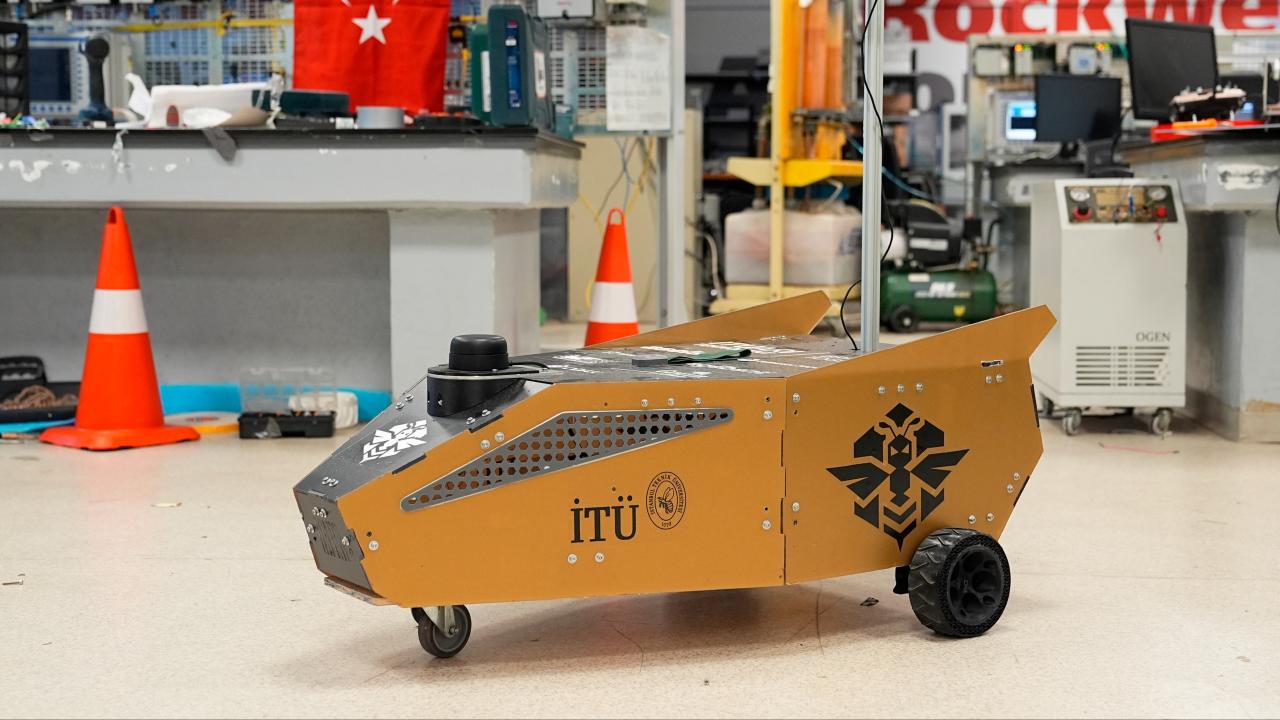
28 teams from 6 countries took part in the competition in Detroit, Michigan, USA.
In the competition, which is considered one of the most renowned international organizations in the field of land vehicles, the autonomous vehicle called “Ayaz” developed by the students successfully mastered the tasks set.
“Ayaz” received high scores from the jury members for its crucial capabilities such as obstacle detection, route planning, autonomous navigation and mission accomplishment by moving fully autonomously on challenging routes.
The ITU RAKE team reached the finals with the autonomous land vehicle they developed and came second in the world.
“We worked on it for a year”
ITU RAKE team captain Ahmet Emre Aktaş said that they started working about a year ago.
Stating that they made search and rescue robots within the scope of the study, Aktaş pointed out that this project was carried out to develop autonomous algorithms.
Stating that they first developed a small prototype vehicle, Aktaş said: “The name of our vehicle is Ayaz. We have fully developed our software and autonomous algorithms in this vehicle.” he said.
Stating that the team consists of students from various engineering disciplines, Aktaş said: “Our team consists of electronics, mechanics, organization and software teams. We are all ITU students. We carried out our regular studies here in the laboratory and worked on the development of this product for a year.” he said.
Stating that they had previously participated in various competitions with different vehicles in Turkey, Aktaş said that with “Ayaz” they took part in the competition in America for the first time and managed to become second in the world.
Aktaş said: “Many teams from different countries around the world have been working for this competition for a year. We represented our country and the ITU there and became second in the world. This makes us very proud. We were very happy, we received the reward of our efforts. We worked hard, we deserve it.” he said.
“We have now started working on aircraft”
Aktaş explained that they want to develop an autonomous search and rescue system in which land and air vehicles can work together.
Stating that they want to build a fleet of search and rescue robots, Aktaş said: “We want to enable them to carry out an operation by communicating with each other from the air and from the land,” he said.
Aktaş stated that artificial intelligence algorithms were also used in the project and that the computer in the vehicle was taught various obstacles and objects that could create obstacles in advance, saying: “The artificial intelligence in the vehicle is trained to say: This is an obstacle, this is not an obstacle, you can go this way, you cannot go this way. Then it decides which way it will take.” he said.
Aktaş emphasized that the aircraft will first scan the disaster area, detect dangerous areas and living beings, and transmit the created map to the ground vehicle, explaining that the land vehicle will autonomously follow the safe route and reach the living beings there.
Bir yanıt yazın