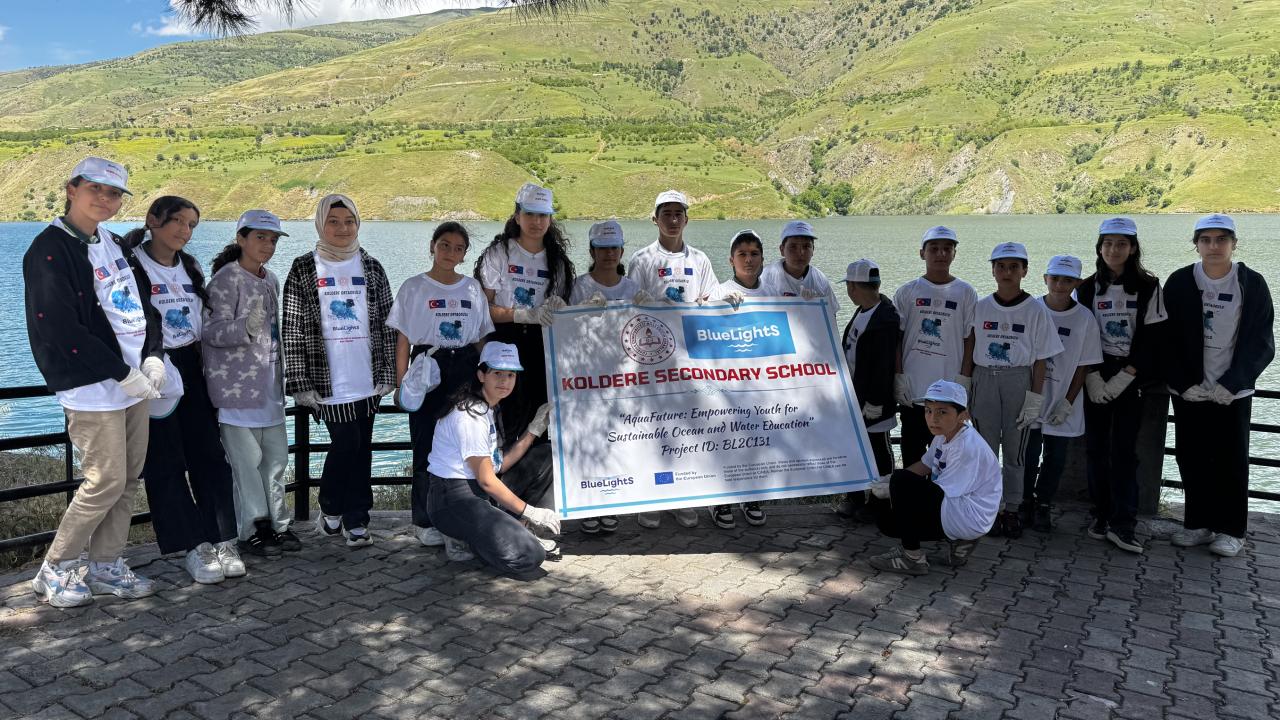
The project, which supports students in schools in Europe to develop projects to protect marine, ocean and freshwater ecosystems, aims to increase water and environmental literacy among young people and encourage them to develop sustainable solutions to the climate and water crises.
As part of the project, the school in Koldere Rural District of Doğanyol District in Malatya also received support from Türkiye. As part of the project, students received various training sessions throughout the year on the importance of aquatic ecosystems, water resource conservation and water efficiency.
The science teacher and project manager of Koldere Secondary School, Dr. Sinem Berber, explained the project application process and its details.
Berber stated that teachers initially had difficulties because the application was written in English, but they completed the application process with research and translation, adding that after approval in September, they conducted weekly exercises with students from February to June.
Berber noted that although the project is aimed only at secondary school students, they are trying to expand it to the entire school, emphasizing that water literacy should be acquired from an early age.
Berber pointed out that they carried out the project studies by integrating them into the teaching program and also made use of extracurricular and weekend opportunities due to time constraints, and stated that the students took part in the lessons and in the project applications despite the mobile teaching conditions.
Berber said: “The content of the project fully includes preventing pollution of seas, rivers and lakes, ensuring conscious use of water, avoiding waste and proper use of water. It is a project fully linked to water literacy.” He pointed out that in addition to the training offered, they try to connect university professors and experts in their fields with the students.
“You can’t just protect it, you have to put it into action.”
Berber pointed out that they are happy to be one of the few schools that won the European Union project and that the students have taken responsibility in the process: “For example, there was a system for calculating the water footprint,” he said.
Explaining that it is motivating for students to experience the happiness of producing through projects, Berber said, “It is really a proud situation. Because water is important, we say blue planet, but we have to protect this blue planet. It is not just about protecting it, it is also necessary to consciously put it into practice. It makes me happy that I can be of use to students at a young age.” he said.
Berber emphasized that the students showed great interest in the project:
“I can say that we are at a bit of a disadvantage in this regard. We are in an area far from the marine environment. At the same time, we are lucky because we have important water resources such as the Euphrates and the Karakaya Dam. Some of our students live near these areas and are aware of the pollution around a larger area over time.
Barber concluded: “We only have one habitable planet. We call it the blue planet. Three-quarters of it is covered in water. We must protect it as if it were our home.” Finally he said:
“It is very important to convey this awareness to our students.”
Galip Öz, principal of Koldere Primary and Secondary School, said that she was particularly pleased that a village school with limited opportunities in Malatya took part in the “BlueLightS Project”.
Öz pointed out that the project is one of the few examples in Turkey, stating that they have received positive feedback and that they are proud of it.
Emphasizing that water is important in every sector, Öz said: “Water is not just drinking water or a resource to be conserved. It is also a very important element in terms of its use in agriculture, its place in the ecosystem and its impact on human health related to the microplastic issue. Therefore, it is of great importance to raise this awareness and bring it closer to our students.” gave his assessment.
Stating that students' active participation in the process accelerates learning, Deputy Principal and Turkish teacher Mehmet Coşkun pointed out that students express their awareness in their daily lives through many practices, from calculating water consumption to reporting broken taps to collecting plastic waste in the environment.
“For a good world we must take care of our environment”
6th grade student Talha Hamza Özkan pointed out that they calculated the water footprint of the classes in the school and said: “Our most economical class was the 7-A class. The least efficient class was the 6-A class. We learned that girls use water more economically than boys. The average total water footprint of our school is 775.” he said.
Emphasizing that life continues thanks to nature, Özkan said: “We make a living thanks to our nature. In the villages, people keep animals or take care of herbs. Some people throw garbage into the environment. This leads to pollution of the environment and the seas and narrowing of the habitats of animals. Therefore, we must protect nature.” he said.
Grade 8 student Gamze Bayram said he conducted a special study with waste caps and collected the caps in classrooms.
Bayram explained that they tried to illustrate the importance of water in the project:
“Water is our most valuable resource in the world. Unfortunately, we are rapidly losing this resource due to reasons such as water wastage and water pollution. When water is polluted, not only we but also aquatic creatures suffer great damage. Their homes and habitats are destroyed. We must protect our environment because we must think about our future. We must protect our environment for our future, for a good environment, for a good world.”
Bir yanıt yazın