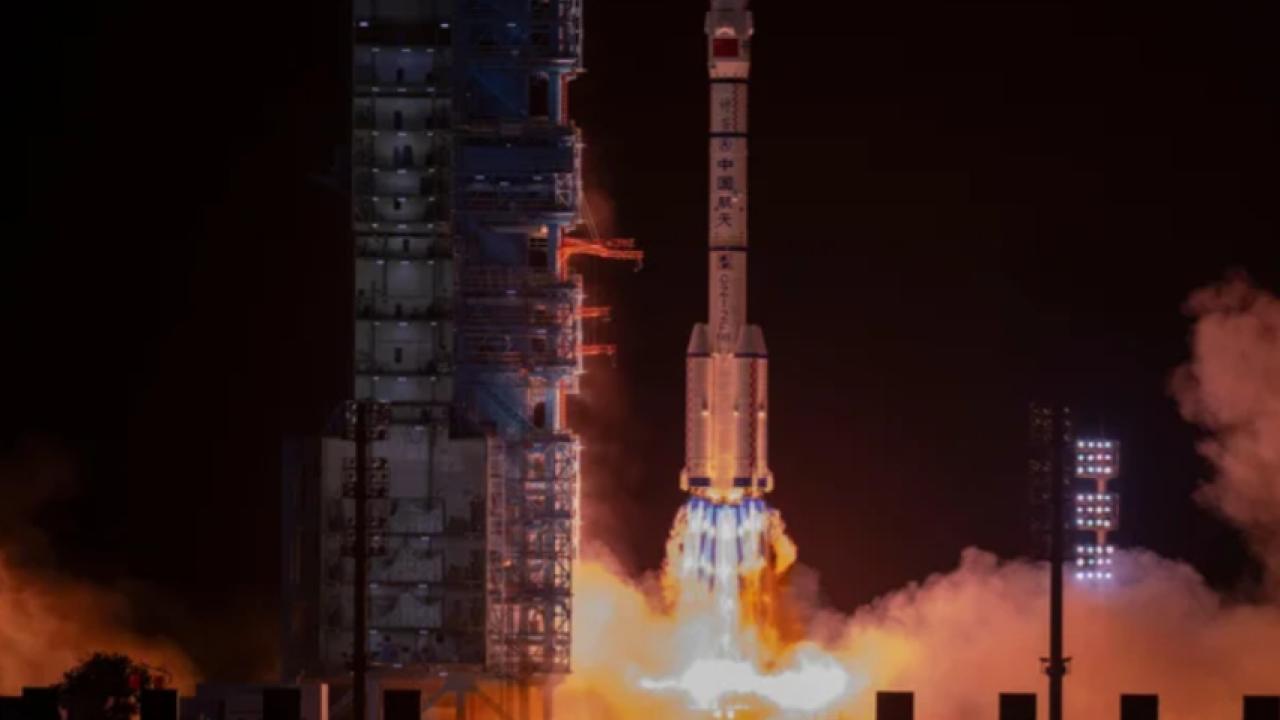
According to the China Manned Space Program Agency (CMSA), the space shuttle Shincou-23 with taikonauts Cu Yangcu, Cang Ciyüen and Lai Ka-ying docked with the station's core module.
After a journey of approximately 3.5 hours, the taikonauts arrived at the station, transferred from the shuttle to the module and entered the space station.
The space shuttle Shincou-23 carrying the Taykonauts was launched yesterday evening on a Long March 2F rocket from the Ciuchuen Satellite Center in the northwest of the country.
The new team replaces the taikonaut team that was sent to the station on the shuttle Shincou-21 on October 31, 2025 and has been in operation for more than 6 months.
First taikonaut in Hong Kong
48-year-old Cu Yangcu, the expedition's flight engineer, was part of the taikonaut team that took part in the “Shincou-16” mission sent into space on the Tiengong space station in May 2023.
Taykonauts Cang Cıyüen and Lai Ka-ying take part in a manned space mission for the first time.
Cang, the pilot of the Shincou-23 shuttle, was previously a fighter jet pilot in the Chinese People's Liberation Army Air Force, and Lai, who took part in the expedition as a payload specialist, served as a chief inspector of the Hong Kong police.
Lai, a computer science student, was the first taikonaut from China's Hong Kong Special Administrative Region to participate in space station missions.
One of the taikonauts will spend a year in space
The deployment period of the new taikonaut team is planned for six months, but unlike previous expeditions, one of the taikonauts will stay on the space station for a year to take part in the experiment, which will study the effects of long-term space expeditions on the human body.
Monitoring team members' health data throughout the mission will determine which name will remain on the space station for a long time.
Prolonged stay in space can lead to effects such as reduced bone density, muscle loss, sleep disorders, physical and psychological fatigue in the human body due to low gravity and radiation.
The record in this area is held by Russian astronaut Valery Polyakov, who spent 437 days (about 14 months) on the Mir space station between 1994 and 1995.
During the mission, the Taykonaut team will also conduct more than 100 experiments and application projects in life sciences, materials science, microgravity fluid physics, aerospace medicine and space technologies.
China's Tiengong space station
China set up its own space station in orbit because the US banned cooperation in space exploration and prevented its participation in the International Space Station (ISS) program.
The “Tiengong” (Sky Palace) station, which consists of a core module, two laboratory modules and a planned space telescope, was built based on the model of the no longer active Russian space station Mir.
The main part of the station, the core module “Tienhı” (Heavenly Harmony), was launched on April 29, 2021, the first laboratory module “Vıntien” (Search for Heaven) was launched on July 24, 2022, and the second laboratory module “Mıngtien” (Dreaming the Skies) was launched on October 31, 2022.
After the installation of the “T” shaped main frame and the addition of laboratory modules to the core module were completed, the station moved to the “Application and Development Phase”.
The “Şüntien” (Wandering the Skies) space telescope will also be added to the station as a separate module.
Personnel are transported by “Şıncou” (Holy Ship) shuttles, and supplies are transported by “Tiencou” (Sky Ship) shuttles to the station, where a three-person team of taikonauts work in rotation.
Bir yanıt yazın