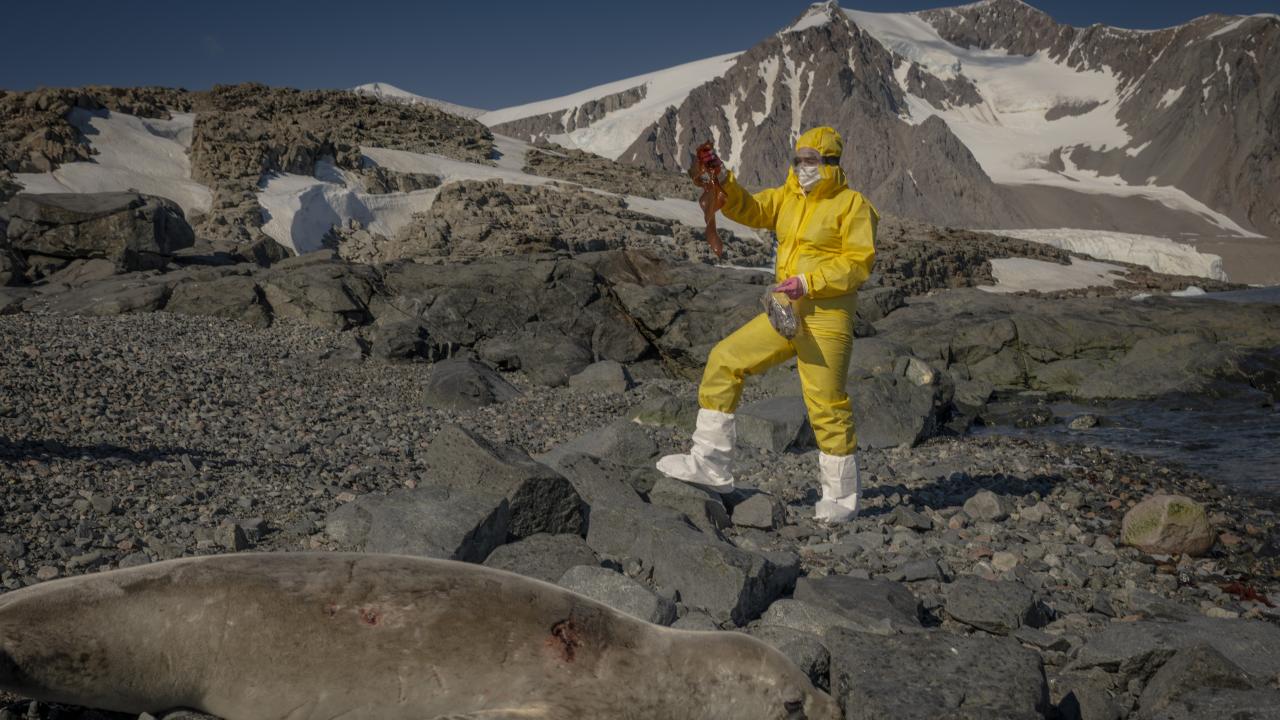
The 10th National Antarctic Scientific Expedition continues under the auspices of the Presidency, the Ministry of Industry and Technology and the coordination of TÜBİTAK MAM Polar Research Institute.
The study, conducted on macroalgae and plant species of the polar ecosystem, will examine the effects of natural compounds against viral proteases and researchers will assess whether these compounds can contribute to the development of new and effective antiviral drug candidates. It is stated that species that survive in extreme conditions can have strong biological characteristics.
On the other hand, the microorganisms living in the Antarctic soil ecosystem are also the subject of separate research. The community structure of these microorganisms adapted to extremely cold and dry conditions is investigated and their future use as biofertilizers is evaluated.
Scientists say that the studies carried out as part of the expedition in Antarctica are aimed not only at understanding polar ecosystems, but are also part of the search for solutions to humanity's health and sustainable agriculture problems. All data obtained in Antarctica affects not only this continent, but also the future of humanity.
“We want to develop new microbial fertilizers”
Dr. participated in the expedition with a research project of the Central Research Institute of Soil, Fertilizer and Water Resources of the Ministry of Agriculture and Forestry, General Directorate of Agricultural Research and Policy (TAGEM). Çağlar Sagun explained that their project is to study the community structures of microorganisms in Antarctic soil under changing climate conditions.
Sagun continued his words as follows:
“Among other things, we have investigated the potential of bacterial and fungal species as microbial fertilizers. With the data we obtain as a result of testing our project, we aim to develop defense strategies against climate change and new microbial fertilizers by using organisms adapted to the effects of climate change.”
“We will investigate the effectiveness of algae and plants against viral proteases.”
Expedition member's research assistant Gözde Yeşiltaş İmamoğlu from Gebze University of Technology explained that she will collect samples of algae and plants in Antarctica and study the effectiveness of these algae and plants against viral proteases.
Explaining that these creatures living in cold climate conditions can produce powerful metabolites, İmamoğlu said, “Can these metabolites develop a treatment method for human health? Is it possible? We will study the possibility.” he said.
Stating that they will extract the samples taken and determine the bioactive active molecules contained in them, research assistant İmamoğlu said:
“We have all become accustomed to viruses invading our lives through COVID-19, and we have seen how helpless we are here and how inadequate our resources are. With this study, we will investigate what effects the bioactive factors in the plants and algae we obtained here have, what kind of treatment and what kind of medicine can be developed.”
Bir yanıt yazın