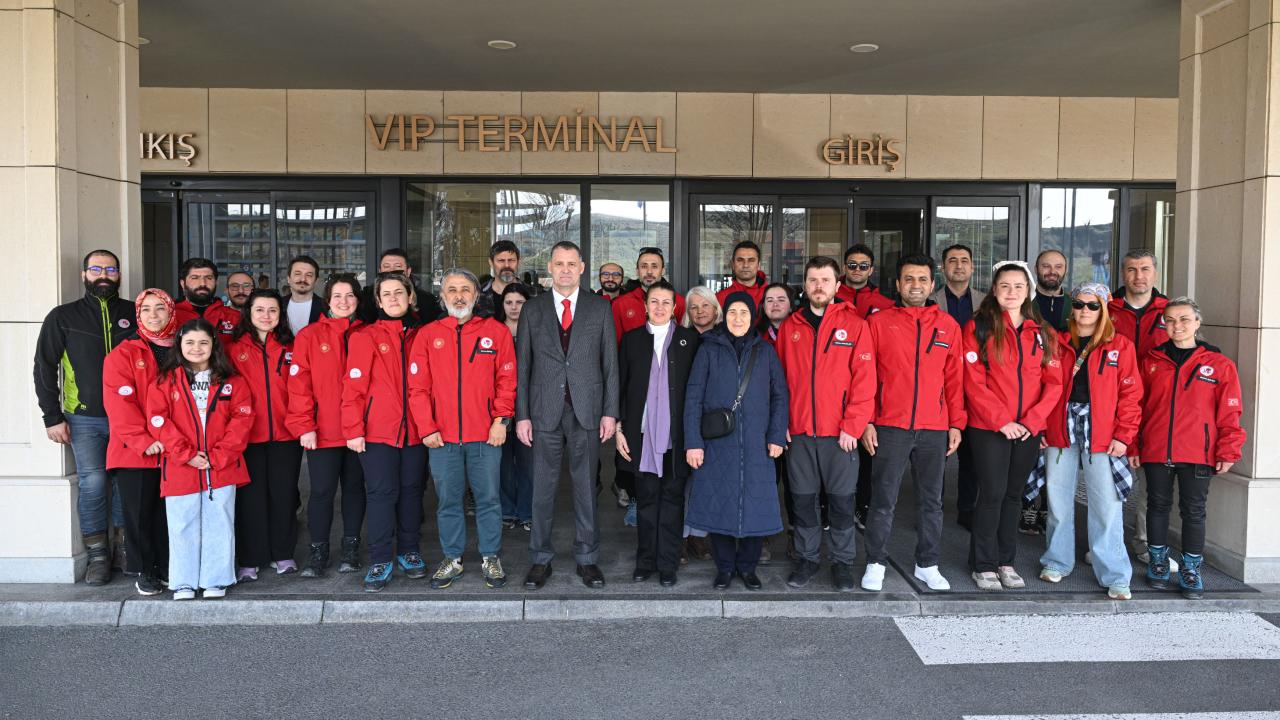
After leaving Istanbul Airport on January 26, the team reached Antarctica after a journey of more than 60 hours via Brazil and Chile and reached Türkiye via the same route.
Researchers from various universities and institutions who participated in Türkiye's 10th Science Expedition this year carried out 15 different projects on site under difficult weather conditions. The aim is to share with the international scientific world the data from 15 projects in various fields, from geosciences to glacier observations, from space exploration to studies of aquatic ecosystems.
After completing its work on Horseshoe Island, the Scientific Committee completed maintenance and data collection work on the Global Positioning Satellite System (GNSS) fixed station on Dismal Island, one of the first stations established outside Türkiye's borders.
From Adelaide Island, the team embarked on a stormy, wavy and snowy voyage through Grandidier Channel, Penola Strait and Le Maire Channel, reaching first Deception Island and then King George Island. The 17-member team reached Chile via this island and then returned home via Brazil.
The delegation, which reached the megacity after traveling about 14,700 kilometers, was welcomed at Istanbul Airport by the Head of Istanbul Airport Civil Administration İlker Haktankaçmaz, officials and their relatives. While the team returning from Antarctica was happy with their relatives, it was observed that some families who came to greet them also brought their pets with them.
15 separate research projects were carried out
The science team conducted 15 research projects this year as part of the 10th National Antarctic Science Expedition.
Turkish scientists, seeking answers to many questions from global climate to earth sciences, from near-space studies to biodiversity, conducted studies focusing on physical and geophysical processes such as climate change, glacial and atmospheric dynamics, geodynamic mobility, seafloor mapping, oceanographic features, near-space measurements and cosmic ray measurements.
He also conducted research on lake and marine ecosystems, microbial and phytoplankton biodiversity, distribution of pollutants, paleoclimatology, medical planning under extreme conditions, as well as biotechnology and the development of new antiviral drug candidates.
“Our goal is to establish a permanent Turkish scientific research base in Antarctica.”
Minister of Industry and Technology Mehmet Fatih Kacır in his statement on the US-based company's social media platform
Kacır said: “With our polar research expeditions, which we carry out under the patronage of our President and under the coordination of our TÜBİTAK Polar Research Institute, we will continue to increase our country's scientific capacity and offer solutions to humanity's global problems. Our goal is to establish a permanent Turkish scientific research base in Antarctica and achieve the status of an 'advisory country' within the Antarctic Treaty System.” he said.
“Research samples and station data were brought to Türkiye”
In a statement to the AA correspondent at the airport, the coordinator of the 10th National Antarctic Scientific Expedition, Prof. Dr. Burcu Özsoy said that the 10th expedition ended this year and that more than 200 Turkish researchers traveled to the Poles and have done important work so far.
Özsoy explained that this year 17 researchers carried out 15 different projects and spoke about the difficulties they faced when traveling to and from Antarctica.
Providing information about the areas in which Turkish scientists are working, Özsoy said that the samples of the research conducted there and the data obtained from the established stations have been brought to Türkiye and that they are excited to see the results.
Özsoy said: “So far, many scientific articles written by Turkish scientists have been released to the world. Based on these studies, our expectations for new scientific articles are high.” he said.
Özsoy pointed out that more than 200 Turkish scientists had the opportunity to carry out physical scientific studies in both the Arctic in the north and Antarctica in the south, explaining that more than 300 scientific articles have been published so far.
Noting that scientific research has had an international impact, Özsoy explained that the poles are called the black box of the planet, that the world's memory is located in these regions, and that millions of years of information and data are hidden in the glaciers of these regions.
Stating that Turkish scientists' studies in the polar regions are of international validity and quality, Özsoy said: “Our Turkish scientists make a great contribution to international scientific literature with their studies in the polar regions.” he said.
“Each layer takes us back hundreds of thousands of years”
Prof. Dr. As part of his research, Burcu Özsoy now asks: “Is there climate change or not?” He explained that they had gone beyond the debate and moved to the level of “fighting climate change” and that they could best understand the world from the polar regions.
Stating that the glaciers are about 500,000 years old and that each layer sets them back hundreds of thousands of years, Özsoy said that it is very important to carry out continuous studies in the polar regions and that the studies to be carried out in the poles will allow them to make predictions for the future by comparing the past and present.
Özsoy mentioned that various countries in the world have established scientific bases in Antarctica and explained that they selected Horseshoe Island as a Turkish scientific base and have carried out very important research since then.
Özsoy reminded that the Ministry of Industry and Technology plans to establish a polar research base in Antarctica by 2030 and talked about the contributions of this base.
“The work we do in Antarctica contributes to world science”
The leader of the 10th National Antarctic Science Expedition, Prof. Dr. Ersan Başar, explaining that they completed their scientific projects within the scope of the expedition, said: “Scientific projects were carried out on 15 different topics. The research was carried out in the fields of earth sciences, marine sciences, glaciology and atmospheric sciences. These samples will be studied in laboratories in Türkiye and published as international articles. In particular, the studies we have carried out in Antarctica contribute to world science.” he said.
Emphasizing that important results have been achieved from the scientific projects they have been carrying out on Horseshoe Island for 10 years, Başar said, “Especially on the Shoesmith Glacier, ice loss of up to 10 meters was recorded in one year. We saw large masses of ice melting rapidly and flowing into the sea in 2026.” he said.
Noting that the weather conditions in Antarctica this year were quite harsh, Başar said: “Wind, storm and snowfall made the work difficult, but our scientists did their work with dedication.” he said.
Geodetic, oceanographic and space observation studies were carried out
On the other hand, the General Directorate of Mapping (HGM) of the Ministry of Defense and the Navigation, Hydrography and Oceanography Division of the Naval Command carried out sea and land measurements on Horseshoe Island as part of the expedition. While HGM performed maintenance, repair and data collection work on the fixed GNSS station, the naval forces conducted hydrographic and oceanographic survey activities.
The expedition also collected data from the Very Low Frequency (VLF) Near Space Observation Station set up on Horseshoe Island and carried out comparative analyzes with the Palmer Station. While the effects of solar activity on radiation were studied through cosmic muon flux measurements, the data obtained was found to be important for space weather forecasting, communications security and climate change monitoring.
Bir yanıt yazın