Uzilday, her husband Assoc. Prof. in the same department. Barış Uzilday and EU Faculty of Agriculture, Horticulture Department, Dr. Studies will continue within the framework of the project entitled “Making Lunar and Mars Regolith Simulants Using Extremophyte Precursor Plants and Investigation of Signal Pathways Related to Stress Responses in Plants Grown in Regolith Simulants” prepared by Faculty Member Tansel Kaygısız for agriculture.
For TÜBİTAK-supported studies that began about 15 months ago, lunar and Mars regolith simulants (with similar structure) were brought from the USA.
First, the plants “schrenkiella parvula”, “arabis alpina” (kazteresi) and “noccaea sempervivum” from the cruciferous family, which survive under harsh environmental conditions such as high temperatures, heavy metal pollution, drought or salinity, were bred.
In this way, an improvement to reduce the high metal and salt content in the structure, which is structurally similar to regolith, was achieved and the growth phase of tomatoes was initiated.
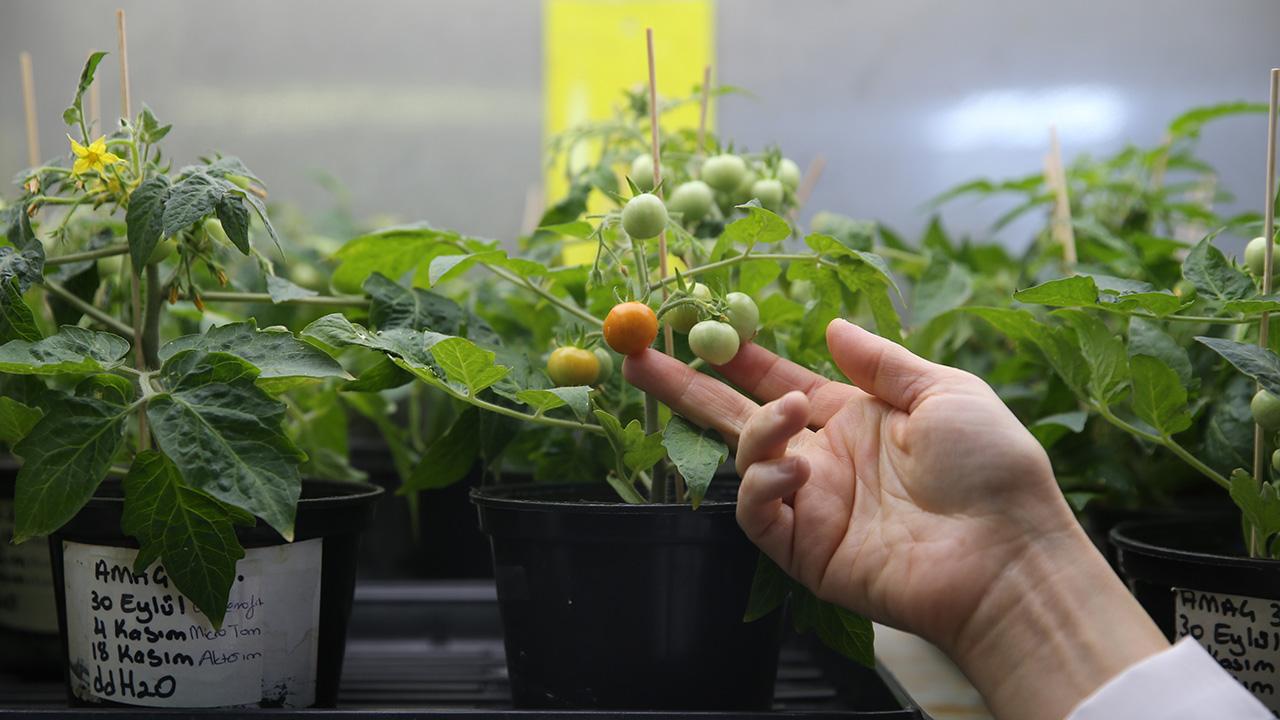
“We have borne fruit”
Assoc. Dr. Rengin Özgür Uzilday said that they are working on space biology.
Explaining that humanity plans to establish colonies on the Moon and Mars, Uzilday explained that growing plants in a microgravity environment in space is possible under limited conditions, which is why they are working on the idea of growing plants in regolith.
Assoc. Dr. Uzilday explained that the regolith known as “lunar and Martian soil” is extremely poor in organic matter, noting that, unlike soil on Earth, there is no natural life in these environments.
Explaining that it is not possible to transport soil from Earth to the Moon or Mars, Uzilday said that they are trying to make the regolith useful for agriculture and that they want to transfer the information gained directly when humans start colonizing the Moon or Mars.
Assoc. Dr. Uzilday explained that in the first phase they aim to biologically improve the regolith with extremophyte plants (which can survive and develop in harsh environmental conditions such as high temperatures, heavy metal pollution, drought or salinity) and that they are able to renew the regolith with the help of “schrenkiella parvula”, “arabis alpina” and “noccaea sempervivum”, which they have safely in one with the experiment they have prepared for Turkey Growing microgravity environment First astronaut Alper Gezeravcı. He explained that they were doing cleaning work.
Explaining that in the second phase of the study, they grew tomatoes in regolith similar to those with reduced metal and salt content, Uzilday said: “We grew extremophyte plants in the regolith of the Moon and Mars. We started growing tomato plants and obtained large quantities of fruits in some of them. In the next phases, we will study the quality and molecular mechanisms of the fruits.”
The analysis is carried out
Tansel Kaygısız, Faculty Member of the EU Faculty of Agriculture, Horticulture Department, explained that the development of the plants continues and that they will carry out detailed quality analysis on the tomatoes that are at harvest maturity.
Kaygısız explained that fruits grown both in soil and in regolith simulations will be compared and that the data to be obtained will provide indications about the edibility of the products.
Bir yanıt yazın