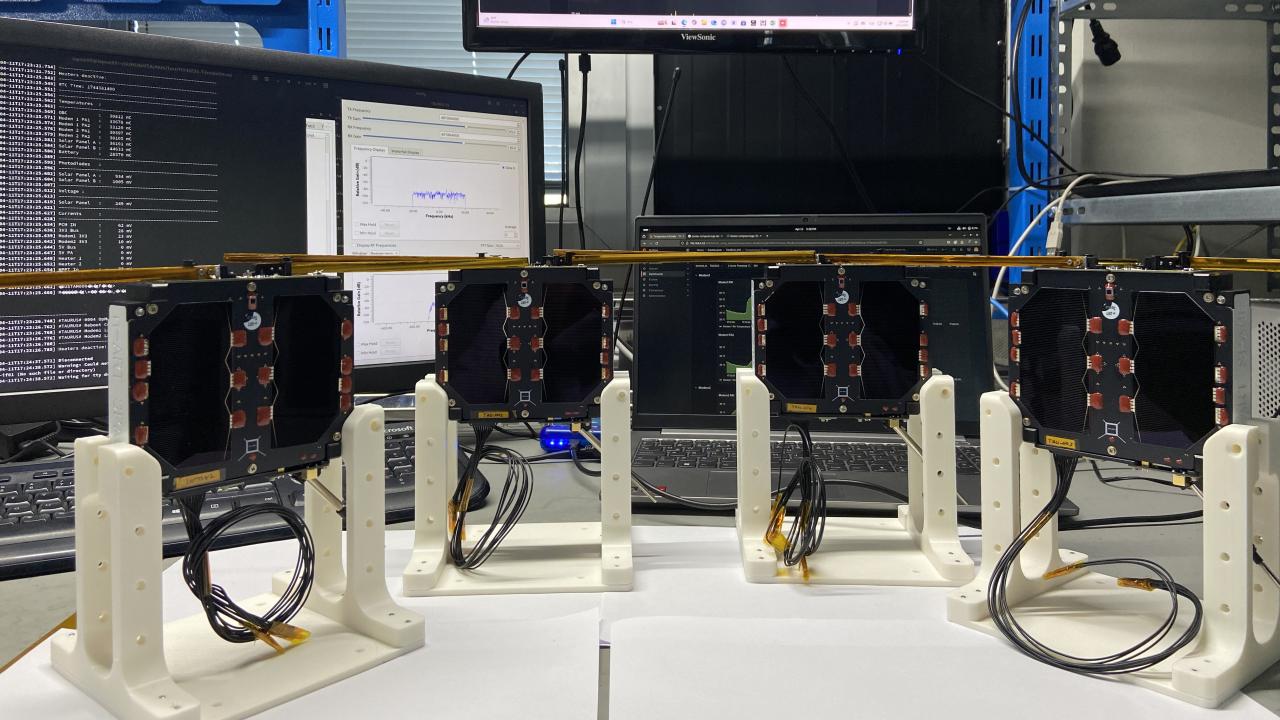
The countdown has begun for the satellites manufactured and developed as part of GUMUSH AeroSpace's work in the field of small satellite technologies to provide IoT (Internet of Things) connections in regions where there is no Internet infrastructure.
The 4 satellites that will take part in the TAURUS pico satellite constellation will be launched tomorrow from the Cape Canaveral base in Florida on the SpaceX Falcon 9 rocket as part of the Bandwagon-4 mission.
TAURUS, which features a modular and scalable 0.25U multi-protocol pico-satellite architecture, is designed for IoT data forwarding and also stands out for its adaptable structure for maritime (AIS) and aviation (ADS-B) missions.
This launch will be the first space mission of the TAURUS constellation architecture and will mark the beginning of an infrastructure-independent, satellite-based IoT communications network.
Satellites will be used to transmit sensor data through space to regions where internet access is not available.
GUMUSH AeroSpace aims to evaluate the TAURUS platform as part of a comprehensive mission and prepare for broader plans for the deployment of constellation satellites in the future. TAURUS is described as “one of the world’s most compact and highly functional 0.25U IoT satellite platforms.”
The satellites, designed in the “0.25U shape” factor (10 cm x 10 cm x 2.7 cm) and weighing just 452 grams, will be launched in a group of four and placed in a 45 degree inclined orbit with an altitude of 510 kilometers. In addition to its size, this mission is also Türkiye's first satellite to be sent into a 45-degree inclined orbit.
With TAURUS, Turkey has become the fourth country in the world to develop multifunctional picosatellites (ultraminiature satellites ranging in size from 0.1U to 0.25U) in this form factor and has also managed to produce one of the smallest but most functional 0.25U platforms in the world.
TAURUS will contribute to cost-effective global sensing and connectivity in areas such as precision agriculture and livestock monitoring, remote industrial and energy infrastructure, maritime security and logistics, aviation situational awareness, disaster response and emergency communications.
While this launch places Türkiye in a competitive position in ultra-miniaturized space systems, it also lays the foundation for exportable satellite technology and scalable constellation infrastructure.
Founded in 2012, GUMUSH AeroSpace is Türkiye's leading private small satellite company specializing in nanosatellite and picosatellite systems. The company develops modular space platforms and IoT-focused advanced space solutions. GUMUSH conducts studies on a global scale by collaborating on international space programs.
Bir yanıt yazın